Edit a daily devotional recording
A daily devotional edit has to be finished in minutes, or the show stops. That's the whole design brief, and it shapes every decision on this page: a saved intro and outro you drop on every episode, one loudness target you hit every time, and a firm decision about how much you're going to fix — which is almost always less than you think. Audacity will do the job and costs nothing, though the per-episode clicking mounts up over a hundred episodes and it has no memory of what you did last time. Hilite opens in a browser tab with nothing to install, so you can trim, level and export a week's worth in one session without moving files between apps.
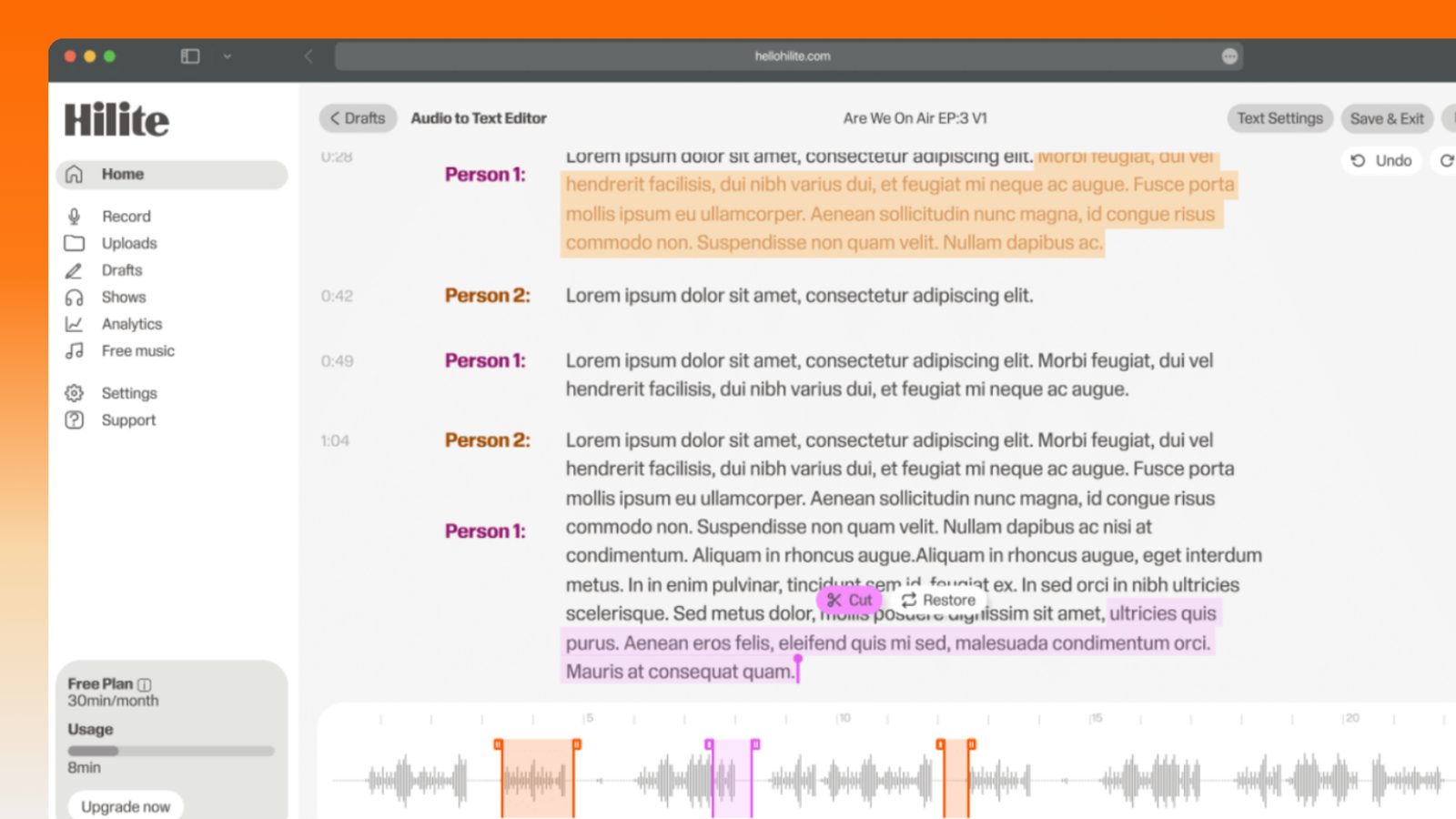
Edit a week of devotionals in four steps
- 1
Build the template once
Settle your intro, your outro, your loudness target and your export settings, and save them somewhere you can reuse. This is a one-off half hour that pays back every day for as long as the show runs.
- 2
Top and tail
Trim to the first word and cut the wind-down at the end where you're checking whether it stopped. Leave a short breath of silence either side rather than cutting flush against speech.
- 3
Fix only what you marked
Go to the gaps and markers you left while recording, take the fluffed line out, and leave the rest alone. Resist the urge to listen through hunting for imperfections — that's how a ten-minute edit becomes an evening.
- 4
Level, export, next one
Drop the intro and outro on, level to your target, export mp3, then open the next episode and do exactly the same thing. Repetition is the point: by the third one you'll be moving quickly.
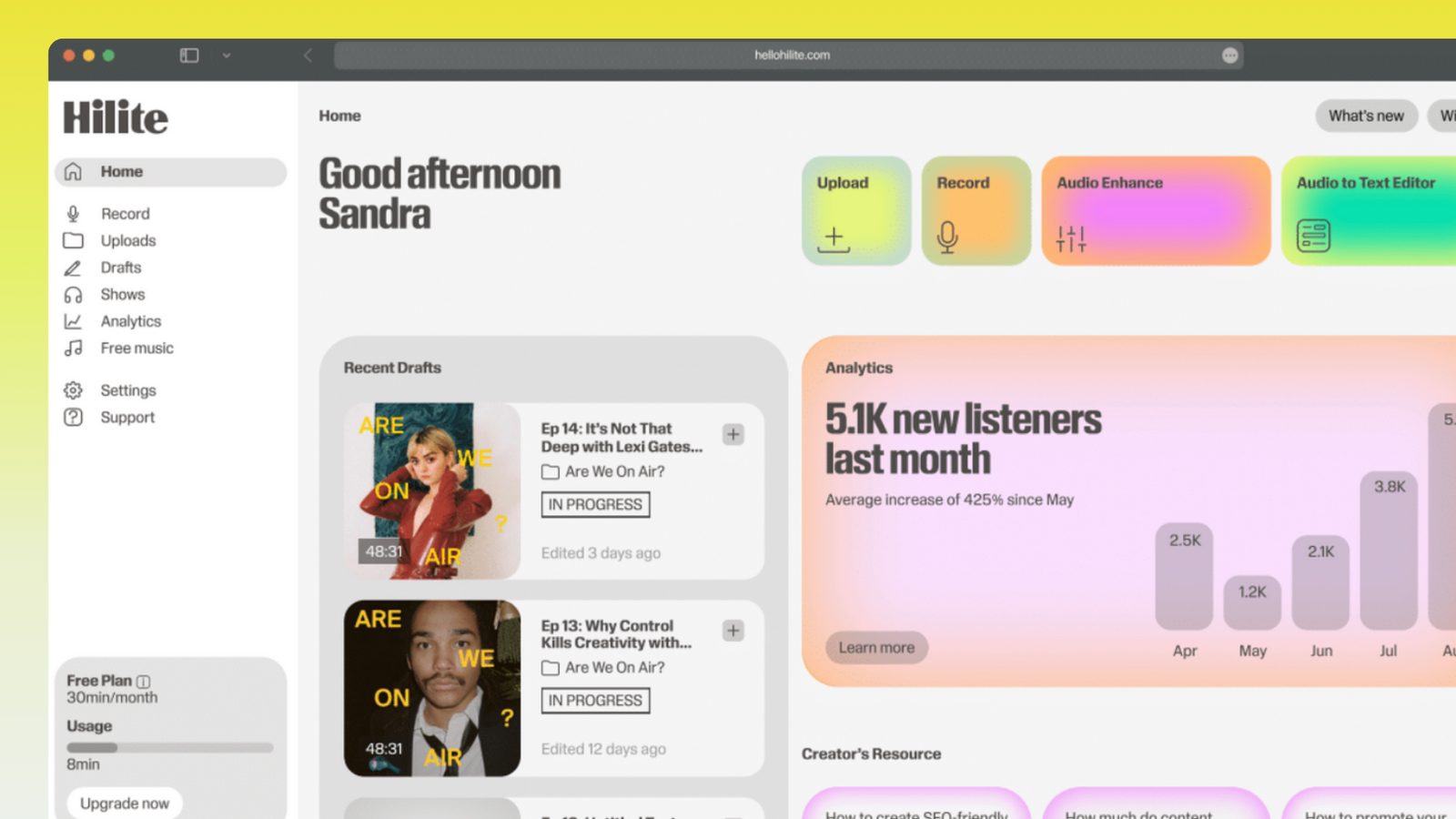
Merge audio inside the Hilite editor
Your uploaded files open directly in a focused editor view. Arrange your clips, preview the timeline, adjust transitions, and export when the track sounds perfectly right.
- Drag to reorder clips
- Trim starts, ends, and gaps
- Preview the full track before export
Input formats
Output formats
Built for every kind of audio
Whatever you are making, this tool helps you get to a cleaner, more useful result, then hand off to Hilite to enhance and polish.
- Minutes, not hoursAt a daily cadence the edit budget is the show's life expectancy. If an episode takes an hour to finish, you will miss days, and a daily show that misses days stops being daily.
- Decide what you won't fixBreaths, small pauses and the occasional um are how speech sounds. Chasing them out costs hours a week and makes the finished thing oddly clipped and less warm.
- One target, whole feedPeople play daily episodes back to back and in the car. A volume jump between Tuesday and Wednesday is the flaw they'll actually notice, so hit the same loudness on all of them.
- A retake beats a rescueIf a sentence came out badly, re-record twenty seconds of it rather than repairing it. Re-reading takes half a minute; editing a broken sentence into shape can take ten.
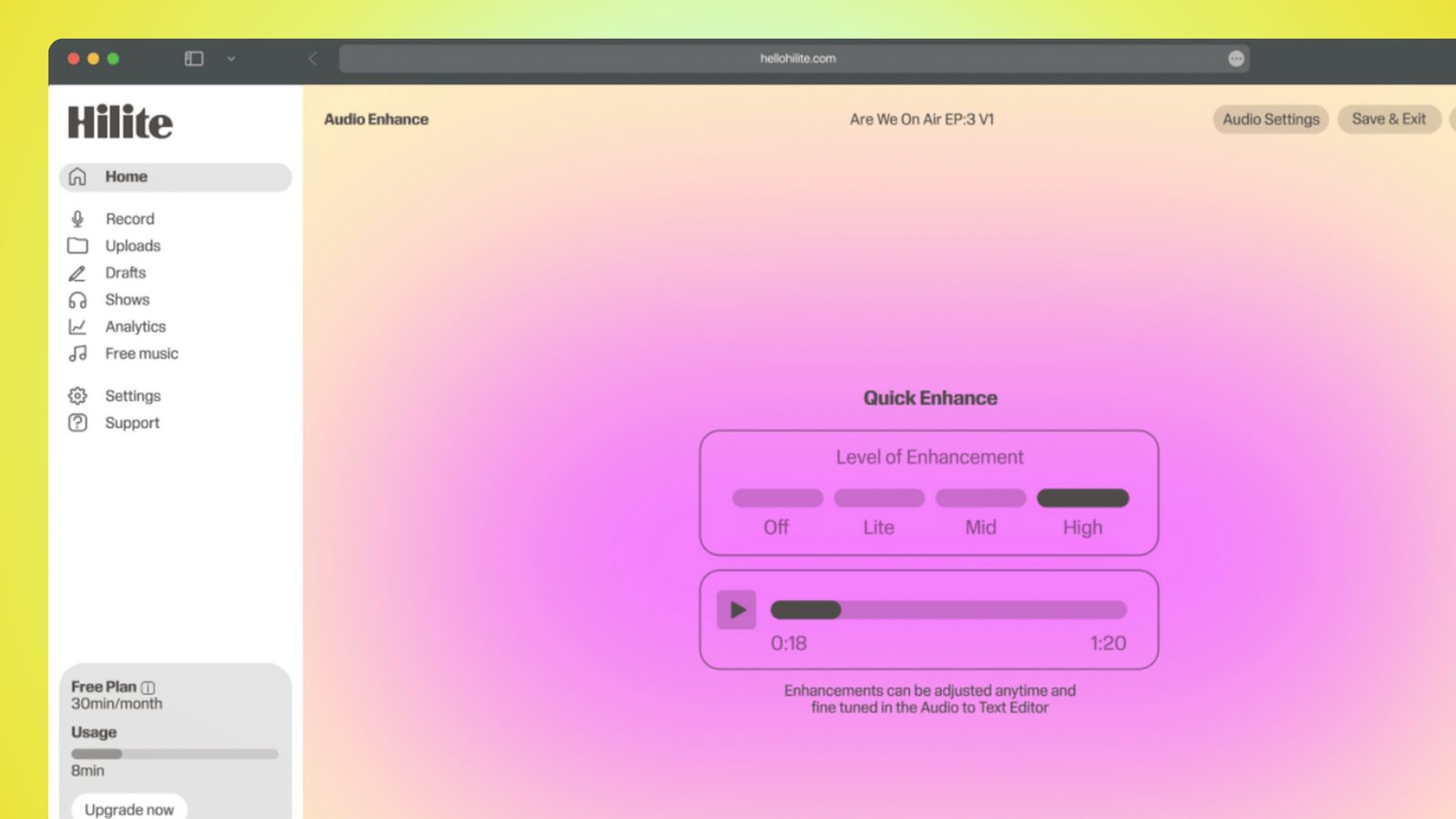
Made for podcasters and their teams
Trim the dead air off the top and tail, and every recording is ready to edit, enhance, and publish.




FAQ
Common questions
If you do not see your question here, the support team replies within one business day.
- Make the same edit every day rather than a bespoke one. Save an intro and outro you drop onto every episode, keep one loudness target, and limit yourself to three actions per file: trim the ends, cut the retakes you marked while recording, level and export. Everything beyond those three is optional, and at a daily cadence optional work is what kills the show. Edit the whole week in one sitting so you're repeating a routine instead of remembering it five separate times.
- Once your template exists, about ten minutes — roughly twice the runtime — and it should get faster. If you're regularly spending forty-five minutes on a five-minute episode, the problem isn't your speed, it's that you've taken on a level of polish the format can't sustain. Time yourself for a week. If the number is going up rather than down, cut something out of the process rather than trying harder.
- No. Breaths and short pauses are what make speech sound like a person talking to you rather than text being read, and removing them all leaves a strange, airless result that listeners describe as rushed without knowing why. Cut the ums that cluster around a genuine stumble and leave the rest. This is also the single biggest time saving available to you: chasing every filler out of a five-minute episode can take longer than recording it did.
- Pick a loudness target and hit it on every export rather than judging by ear, because your ears adjust within a minute of listening and will happily tell you a quiet file is fine. The common target for spoken-word podcasts is around -16 LUFS integrated for stereo, or about -19 LUFS for mono, with peaks kept below -1 dB. Write the number down next to your recording settings. Consistency across the feed matters more than the exact figure you choose.
- Work in passes rather than finishing one episode at a time. Trim all five, then cut the marked retakes on all five, then level and export all five. Doing the same action repeatedly is much faster than switching between different kinds of work, and it keeps your decisions consistent — the trims will match, the levelling will match, and the week will sound like one week. Name the files as you export so Thursday doesn't end up published on Wednesday.
- Almost any time a whole sentence is wrong. Reading twenty seconds again takes about twenty seconds; stitching a broken sentence together from two takes can take ten minutes and often still sounds joined. Re-record if you misspoke, if a siren went past, if you lost your place, or if the energy dropped out of a paragraph. Edit rather than re-record when it's a single word, a cough in a gap, or something you can simply lift out cleanly.
- A short one, yes, and the emphasis is on short. A few seconds naming the show and the day is enough to orient someone who arrived from a search or a share, and an outro gives you a fixed place to say where to find the rest. Keep it under about fifteen seconds: on a five-minute daily episode, a minute-long intro is a fifth of the show, and daily listeners hear it every single day. Save it once and drop the same file on every episode.
- Mono mp3 at 96 to 128 kbps is plenty for a single speaking voice, and it halves the file size compared with stereo for no audible loss on speech. That matters more at a daily cadence than it does for a weekly show, both for your hosting allowance and for listeners downloading over mobile data. Keep the same settings on every episode, and export a transcript at the same time — it takes seconds and gives you episode notes and something for search to read.
Make the edit boring
Same three actions, same loudness, whole week in one sitting — that's what keeps a daily show going.