Edit a guided meditation recording
Audacity will do every edit on this page for free, and if you already know Audacity you should use it. What's worth knowing before you open anything is that the ordinary podcast editing instinct — tighten it up, cut the breaths, close the gaps — is the wrong instinct for this material. The listener's breathing entrains to yours, so an audible in-breath is doing real work, and a pause you performed is content rather than dead air. The script and the recording are separate jobs; this page starts at the point where you have a take on your hands. Hilite runs in the browser with nothing to install, and does the four things this particular edit needs: a trim, a fix for the line you fluffed, a music bed and a level pass.
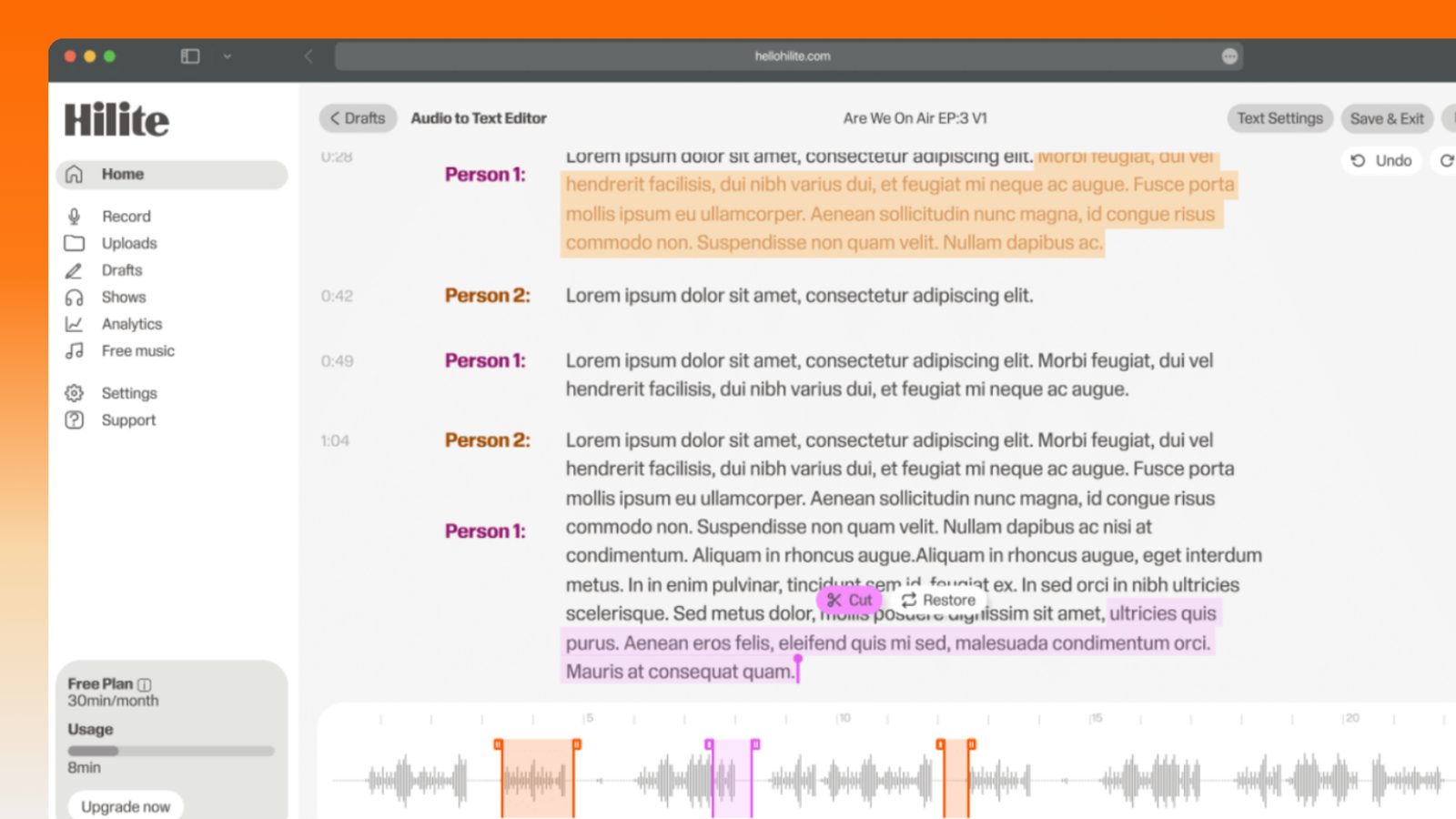
Edit a guided meditation in four steps
- 1
Trim the ends, not the middle
Cut the shuffling before your first line and the reach for the stop button after your last, and leave a second or two of clean room tone at each end to fade into. Then stop trimming. Everything between those two points is paced the way you performed it, and tightening the gaps is the single most common way people ruin a take that was fine.
- 2
Punch in over the fluff
Find the sentence you tripped on and the clean retake you recorded straight after it, and cut the bad one out. Make both cuts in silence, on a breath boundary rather than mid-phrase — the join disappears if the splice sits where a pause already was. If you didn't record a retake, record one now with the mic in the same place and your voice at the same energy, and drop it in the same way.
- 3
Take the floor down gently
Run noise removal on the lowest setting that makes the hum go, then listen to a spoken line, not to the silence. If the voice has picked up a hollow, swimmy, underwater edge, or the tails of your s sounds have gone glassy, you've gone too far — back it off. A faint, steady hiss you can barely hear is better than a processed voice.
- 4
Bed it, level it, export
Drop the music underneath, fade it in over several seconds before your first word and out over several after your last, and set it low enough that you'd notice if it stopped but not while it plays. Then level the whole thing so a bedtime listener never touches the volume, and export an mp3 with a transcript for the description.
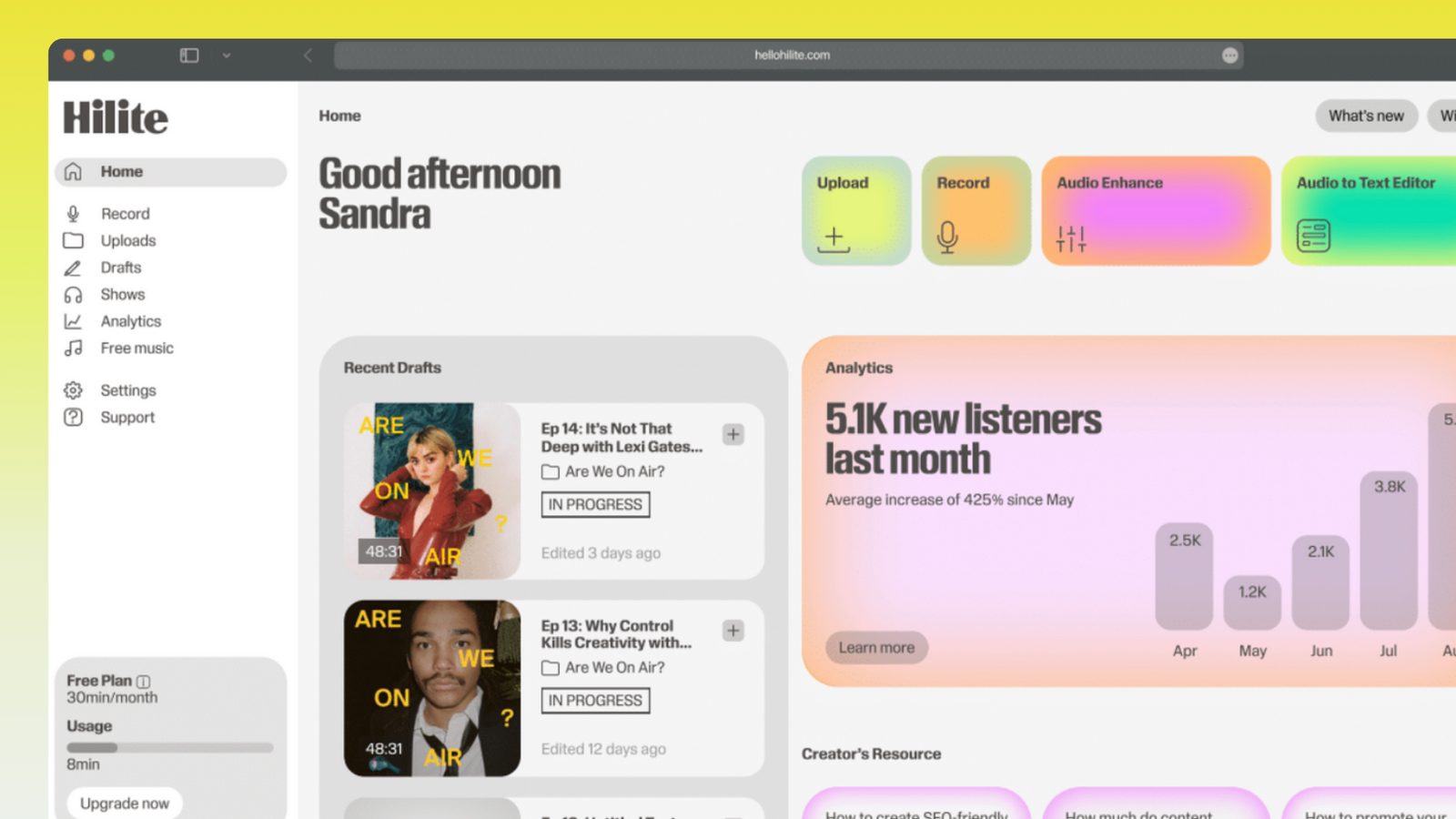
Merge audio inside the Hilite editor
Your uploaded files open directly in a focused editor view. Arrange your clips, preview the timeline, adjust transitions, and export when the track sounds perfectly right.
- Drag to reorder clips
- Trim starts, ends, and gaps
- Preview the full track before export
Input formats
Output formats
Built for every kind of audio
Whatever you are making, this tool helps you get to a cleaner, more useful result, then hand off to Hilite to enhance and polish.
- Keep the breaths inYour in-breaths cue the listener's, which is half of why a guided track works at all. Strip them out and the result goes mechanical in a way nobody can name.
- Pauses are not dead airThe silence between lines is where the listener actually does the thing you asked them to do. Trim the top and tail, then leave the middle alone.
- Clean without the hollowLong silences expose the noise floor, so this material needs more noise reduction than a podcast — and it's also the material where pushing too far turns the voice underwater.
- No hand on the volumeSomeone listening in the dark shouldn't have to find their phone. Levelling keeps the quietest line audible without letting the loudest one jolt them.
Made for podcasters and their teams
Trim the dead air off the top and tail, and every recording is ready to edit, enhance, and publish.




FAQ
Common questions
If you do not see your question here, the support team replies within one business day.
- No. This is the one place the standard podcast advice actively works against you. Listeners breathe with the voice they're following, so an audible in-breath before a line is an instruction they obey without noticing, and the pace of your breathing sets theirs. Take the breaths out and you get a track that's technically clean and somehow airless, which is why so many home-made meditations feel mechanical without the maker being able to say why. Remove a breath only when it's a gasp, a click or a gulp that pulls attention to itself.
- Leave them as recorded. In a meditation the silence is the content — it's when the listener actually scans their body, or follows the breath you just described. Judging it in an editor is misleading, because you're sitting up, looking at a waveform and reading ahead, so every gap feels like an eternity. Your listener is lying down with their eyes closed and experiences the same gap as barely enough. If a pause genuinely is too long, it's usually a sign to re-record the section rather than to splice time out of it.
- Punch in. Record just the sentence you fluffed, then cut the bad version out and drop the new one into the hole. Two things make it invisible: match the conditions, so same mic, same distance, same seat, same time of day if you can, and preferably the same session; and make both cuts in silence rather than mid-phrase, so the join sits where a pause already was. Cutting on a breath boundary hides almost anything. Cutting between two words inside a flowing line almost never sounds right.
- Use the least amount that works, and judge it on the voice rather than on the silence. Noise reduction works by deciding what is noise and subtracting it, and the quiet detail of a human voice — breath, the end of an s, the air around a soft word — looks a lot like noise to it. Turn it up until the hum goes, then listen to a spoken sentence. Hollow, swimmy, slightly robotic, or s sounds that shimmer, all mean back it off. In a meditation you notice the processing far more than a faint hiss, because there's so much silence to hear it in.
- Much quieter than you think while you're mixing it. A good test: if the bed stopped, you'd notice immediately, but while it's playing you shouldn't be able to attend to it. Practically, that usually means the music sits well under the voice — quiet enough that it never competes with a whispered line. Two other things matter more than the number. Choose a bed with no melody, no obvious rhythm and no build, because anything with structure pulls attention out of the words. And fade it in over several seconds before the first line and out over several after the last, rather than cutting it on.
- Level it, but gently. You do want a consistent overall loudness, because your listener is in bed in the dark and shouldn't have to hunt for the volume button — a quiet line they can't hear, or a loud line that jolts them, both break the thing you're making. What you don't want is a hard podcast-style compressor squeezing every syllable to the same size, which makes a soft delivery sound pushed and brings the room noise up in the gaps. Aim for a modest, even level across the whole track, with the natural rise and fall of the reading still intact.
- Yes, and it's free and capable. Audacity does trims, splices, noise reduction, a second track for the music bed and envelope fades, which is everything on this page. The honest trade-offs are that it's a download and an install, so it's no use on a locked-down work or school machine; noise reduction takes a bit of practice to get subtle; and the interface assumes you already know what a decibel is. If you know it, use it. If you're opening it for the first time to fix one recording, a browser editor gets you there faster.
- An mp3 at a reasonably high bitrate suits almost every destination — meditation apps, podcast hosts, your own site — and keeps a long track down to a sane file size. Export a wav instead only if the platform asks for one or you're handing the file to someone who'll do further work on it. Keep the master project or the untouched original either way, because the first thing anyone asks for is a version with different music. And take a transcript while you're there: it does double duty as the track description and as accessible captions.
Edit it without flattening it
Trim the ends, keep the breaths, bed the music low and level it once, all in a browser tab.