Edit a sermon recording
Most sermon recordings need one thing far more than they need anything else, and it isn't trimming — it's levelling. Preaching has an enormous dynamic range: the same person drops to a near whisper for a line and then fills the room a sentence later. That works beautifully in a building and badly in a car, where the quiet part vanishes under road noise and the loud part sends someone reaching for the dial. Audacity will do all of this for free if you're willing to learn compression, normalisation and where they live in the menus. Hilite opens in a browser tab on the church laptop, needs no install and no IT request, and gives you levelling as one control instead of three effects and a manual.
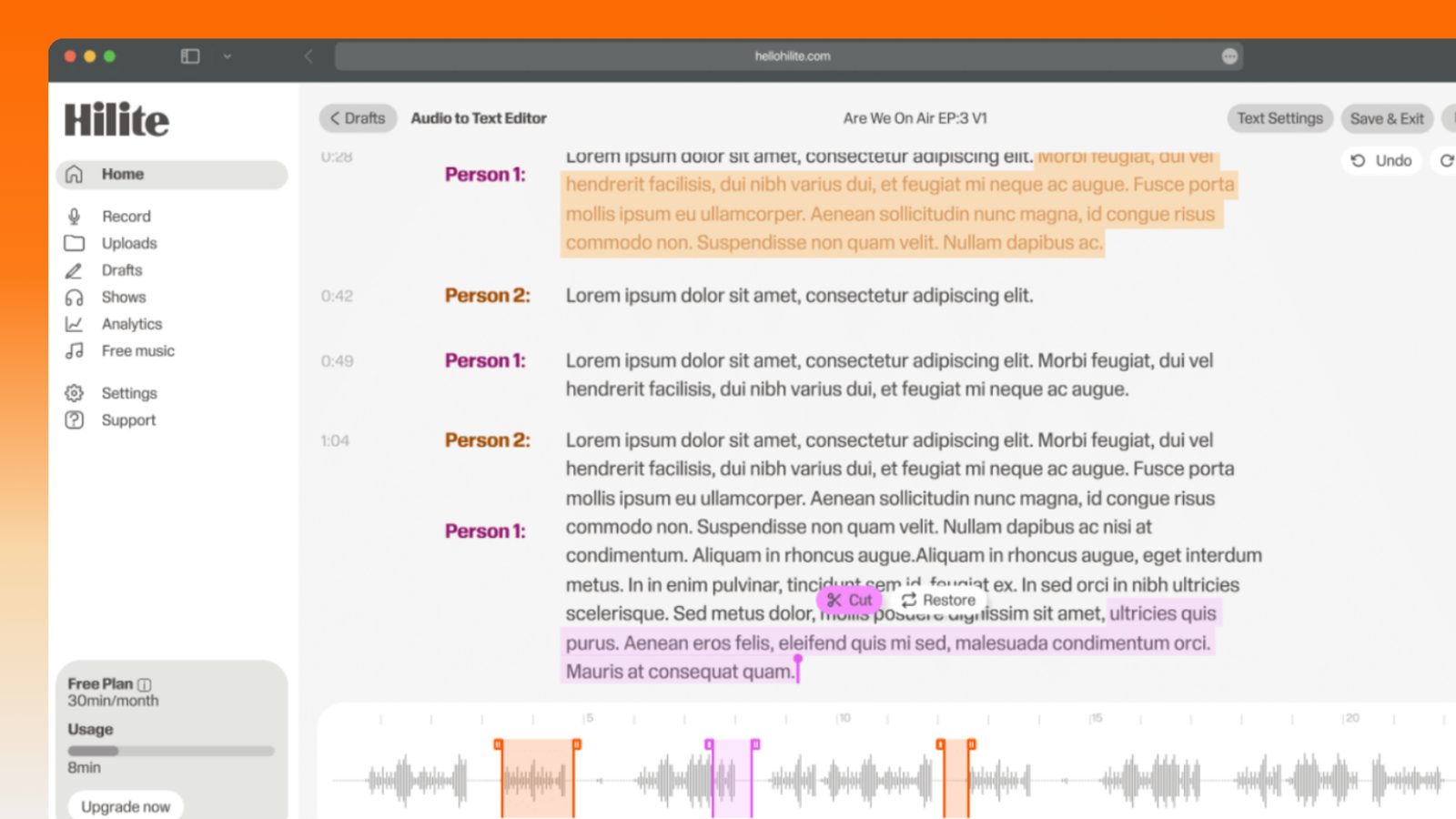
Edit a sermon recording in four steps
- 1
Find the real start
Cut the notices, the walk-up and the shuffle so the file begins at the first sentence of the sermon. Leave a beat of room tone before that first word rather than starting hard on it — a cold start sounds like a mistake.
- 2
Deal with the worship music
If songs are on the same file, decide now: cut them out, or split them into a separate recording you keep for the church rather than the feed. Doing it first means everything after this is a file you're free to publish.
- 3
Level the whole thing
Run levelling across the full recording so the quiet lines come up and the loud ones stop shouting. Then listen to one quiet passage and one loud one back to back — if you don't want to touch the volume, it's done.
- 4
Match the target and export
Aim for the same loudness you used last week, check the last few seconds don't cut off mid-word, and export mp3. Grab the transcript at the same time for show notes and the website.
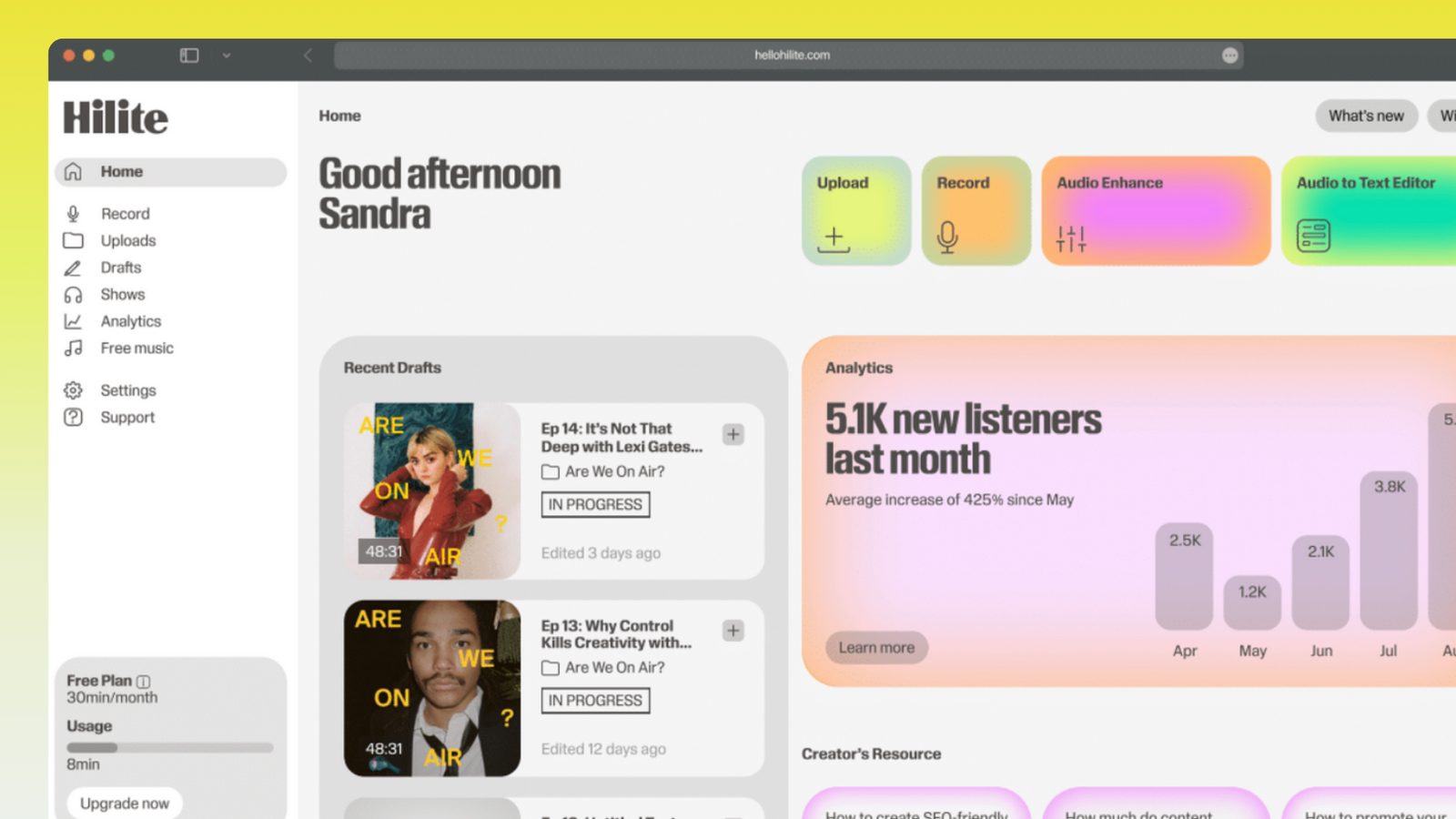
Merge audio inside the Hilite editor
Your uploaded files open directly in a focused editor view. Arrange your clips, preview the timeline, adjust transitions, and export when the track sounds perfectly right.
- Drag to reorder clips
- Trim starts, ends, and gaps
- Preview the full track before export
Input formats
Output formats
Built for every kind of audio
Whatever you are making, this tool helps you get to a cleaner, more useful result, then hand off to Hilite to enhance and polish.
- Levelling beats everythingIf you only do one thing to a sermon file, even out the volume. It is the single edit most listeners actually notice, because most of them are listening while driving, walking or washing up.
- Keep the room in itLaughter, an amen, a long silence people are sitting in — that's the congregation, and stripping it out leaves a lecture. Level it so it doesn't jump, but don't cut it.
- Match last weekA podcast feed is heard as one thing. Hitting the same loudness target every week matters more than hitting a perfect number once.
- Handle the music firstIf worship is on the same recording, deal with it before anything else. Most churches publish the sermon on its own, and that decision saves a licensing headache later.
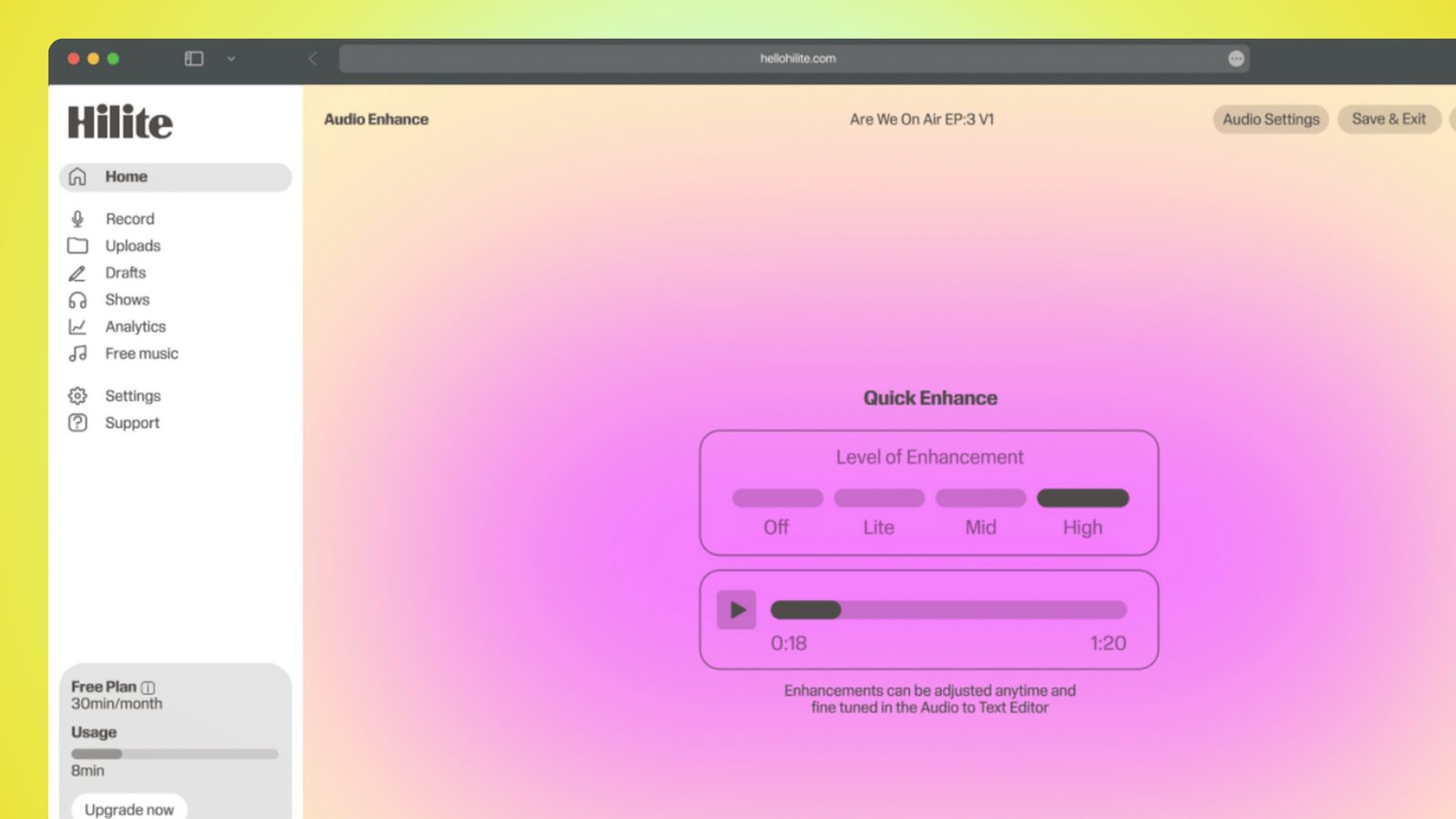
Made for podcasters and their teams
Trim the dead air off the top and tail, and every recording is ready to edit, enhance, and publish.




FAQ
Common questions
If you do not see your question here, the support team replies within one business day.
- Four passes, in this order. Trim the front so the file starts at the sermon and the back so it doesn't trail off. Remove or split out any worship music. Pull down steady background noise like hum or air conditioning. Then level the whole recording so the quiet and loud passages sit closer together, and export at the same loudness you use every week. For a typical sermon that's ten to fifteen minutes of work once you've done it a few times.
- Because preaching is genuinely like that, and a microphone records it honestly. A preacher will drop to a whisper on a line they want people to lean into and then lift to fill the whole building thirty seconds later, and the gap between those two can be enormous. In a room your ears and the acoustics handle it. Through earbuds on a train, or in a car, the quiet part disappears completely. Levelling — compression followed by a consistent output loudness — closes that gap without flattening the delivery.
- The common target for spoken-word podcasts is around -16 LUFS integrated for stereo, or about -19 LUFS for a mono file, with true peaks kept below -1 dB. Most platforms normalise on playback anyway, so the precise number matters less than people think. What matters a lot is that every episode in your feed hits the same one — a listener going through three sermons in a row will notice a jump between episodes long before they notice that your target was a decibel off.
- No. Those responses are part of what the recording is — they tell a listener at home that this happened in a room full of people, and a sermon with every trace of the congregation removed sounds oddly airless. What you should do is stop them jumping out. A laugh or an amen picked up loudly by an open mic can be far louder than the preaching around it, so level it down rather than deleting it. The exception is anything personal said from the floor, which is worth cutting for the sake of the person who said it.
- Treat this as a separate question from the sermon, because it usually is. A church copyright or streaming licence typically covers live streaming a service, but on-demand distribution — a podcast feed, a downloadable file — is often not included and can need separate permissions. Recording a commercial track played over the PA is a different matter again and is rarely covered. The practical route most churches take is to publish the sermon on its own and keep the full service recording for the church's own use. If you want the music in the feed, check the terms with your licence provider first.
- Use noise removal, which listens to the steady background and subtracts it, and use it gently. A hard setting will take the hiss away and leave the voice sounding thin and underwater, which is a worse trade than a little background noise. Do it before levelling, not after, because levelling raises quiet passages and will bring any remaining noise up with them. Coughs, chair scrapes and one-off bangs aren't background noise and won't be caught by it — cut those by hand.
- Yes, and this is often the real constraint rather than a preference. Church laptops are frequently shared, old, or locked down by whoever set them up, and getting software approved and installed can take longer than the editing does. A browser-based editor needs no admin password, works the same on Windows, a Mac or a Chromebook, and means the next volunteer can pick it up on whatever machine is free. Audacity is excellent if you can install it; if you can't, this is why the browser option exists.
- Less than you might expect. Pauses that feel long while you're editing usually feel right at listening speed, and preachers use silence deliberately. Cut the genuine mistakes — a false start, a long fumble for a Bible reference, a two-minute technical failure — and leave the texture. The one thing worth being ruthless about is the front of the file: nobody has ever wished a sermon recording started with four minutes of notices.
Level it, match last week, publish
Open the file in a browser tab and leave fifteen minutes later with something that sounds the same as every other Sunday.