Edit a sleep story recording
Editing a sleep story is a hunt for sudden events. Nothing in the finished file may startle: not a swallow, not a chair creak, not a consonant that spikes above everything around it. At bedtime volume with earbuds in, those are the things that wake somebody who was almost gone, and next to them the usual polish barely matters. Audacity will do all of this free if you're patient with it and don't mind installing something. Hilite does the same job in a browser tab, levelling and cleaning the whole file at once, which is where most of the startles are hiding.
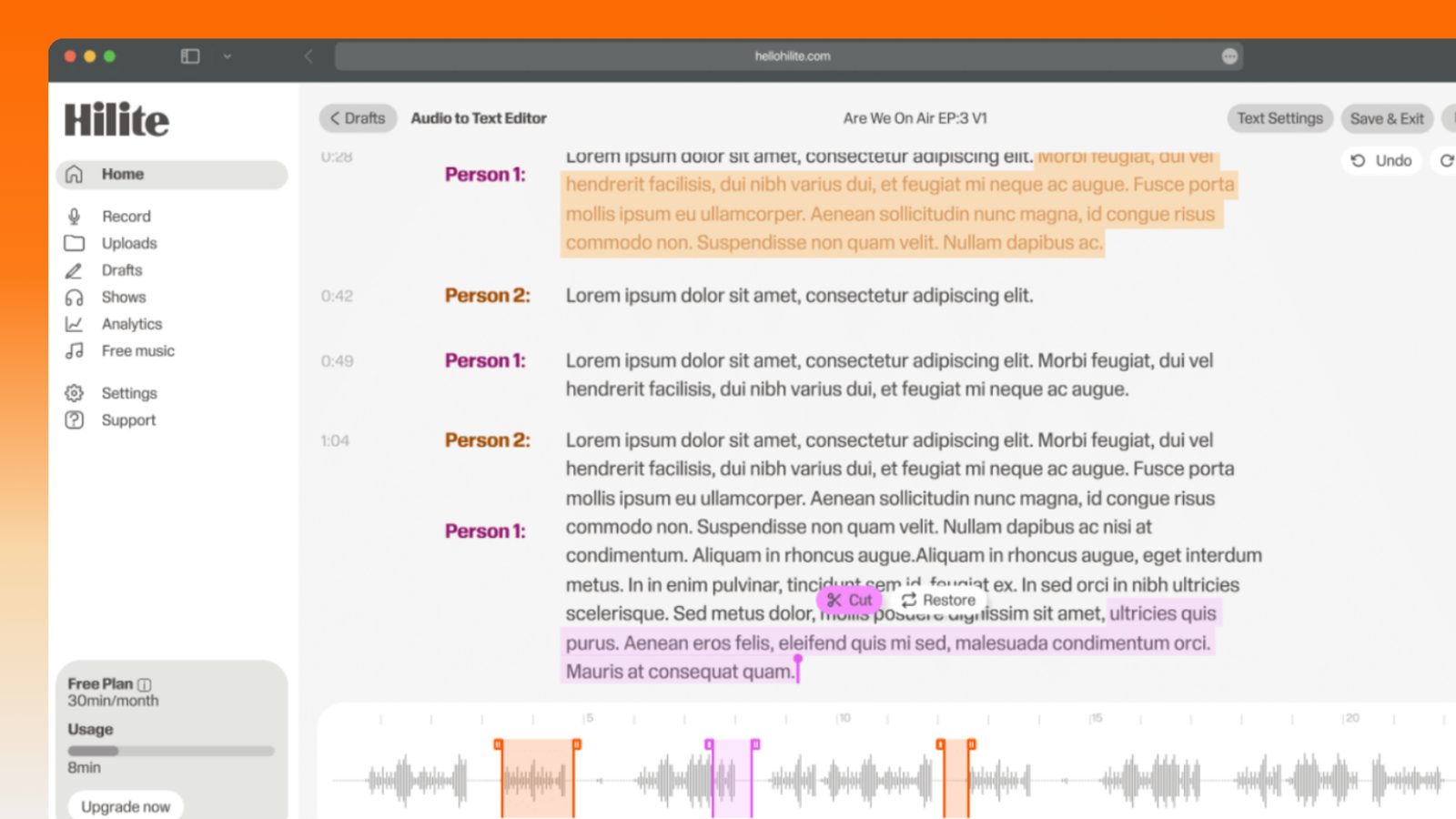
Edit a sleep story in four steps
- 1
Scan the waveform for spikes
Look before you listen. Anything that stands visibly taller than the line around it is a candidate — a swallow, a chair, a door, a hard consonant. Check each one, and deal with it rather than hoping it's too small to hear.
- 2
Take the sudden noises out
If the noise sits in a gap, replace it with a little of the room tone from either side rather than dropping in digital silence, which is itself a jump. If it's on top of a word, lower just that moment instead of cutting, so the sentence stays whole.
- 3
Level the whole file, then de-ess a little
One levelling pass across the entire recording, aiming somewhere around -18 to -20 LUFS with peaks kept well down — deliberately quieter than a podcast. Then soften the S sounds gently; overdo de-essing and the voice develops a lisp, which is its own distraction.
- 4
Fade the ending long, then export
Thirty seconds is the minimum and a couple of minutes is better, starting the fade after the last words rather than over them. Listen back on earbuds at bedtime volume before you export, all the way to the end.
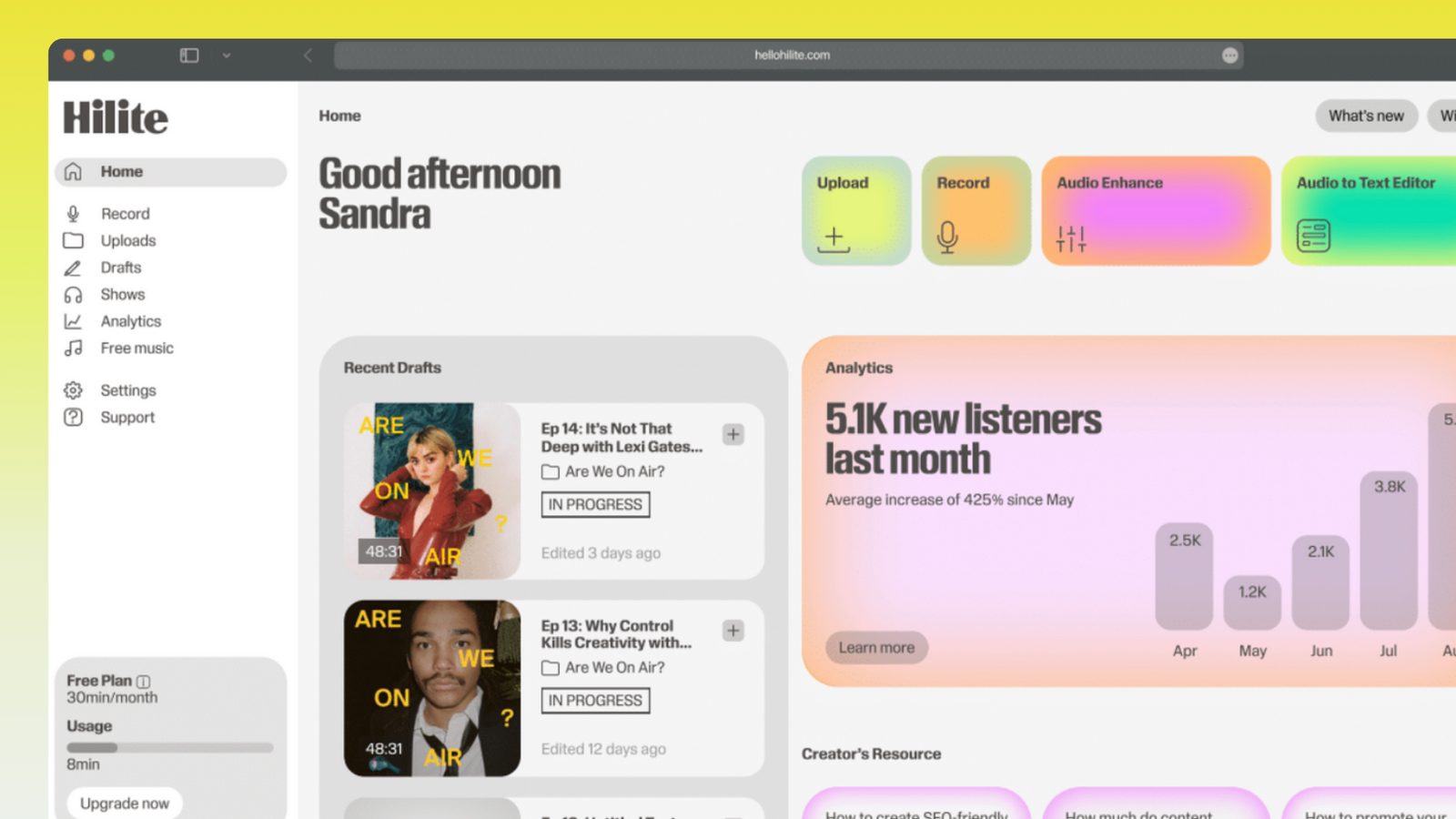
Merge audio inside the Hilite editor
Your uploaded files open directly in a focused editor view. Arrange your clips, preview the timeline, adjust transitions, and export when the track sounds perfectly right.
- Drag to reorder clips
- Trim starts, ends, and gaps
- Preview the full track before export
Input formats
Output formats
Built for every kind of audio
Whatever you are making, this tool helps you get to a cleaner, more useful result, then hand off to Hilite to enhance and polish.
- Hunt startles, not blemishesA slightly uneven sentence never woke anyone. A swallow, a creak or a spiked T at minute 18 does. Work through the file looking for sudden events and ignore everything that's merely imperfect.
- Flat is the targetYou want no loudest moment. If one sentence sits clearly above the rest, bring it down rather than lifting everything else, and keep the whole file quieter than you'd master a podcast.
- Compression is the wrong toolHeavy compression evens things out by lifting the quiet parts — and in a sleep story the quiet parts are quiet on purpose. It also raises the room hiss, the breaths and the mouth noise you were trying to bury.
- End with a taperA file that simply stops is a change, and changes wake people. Let the last few minutes drift down in volume so the recording arrives at silence gradually rather than cutting to it.
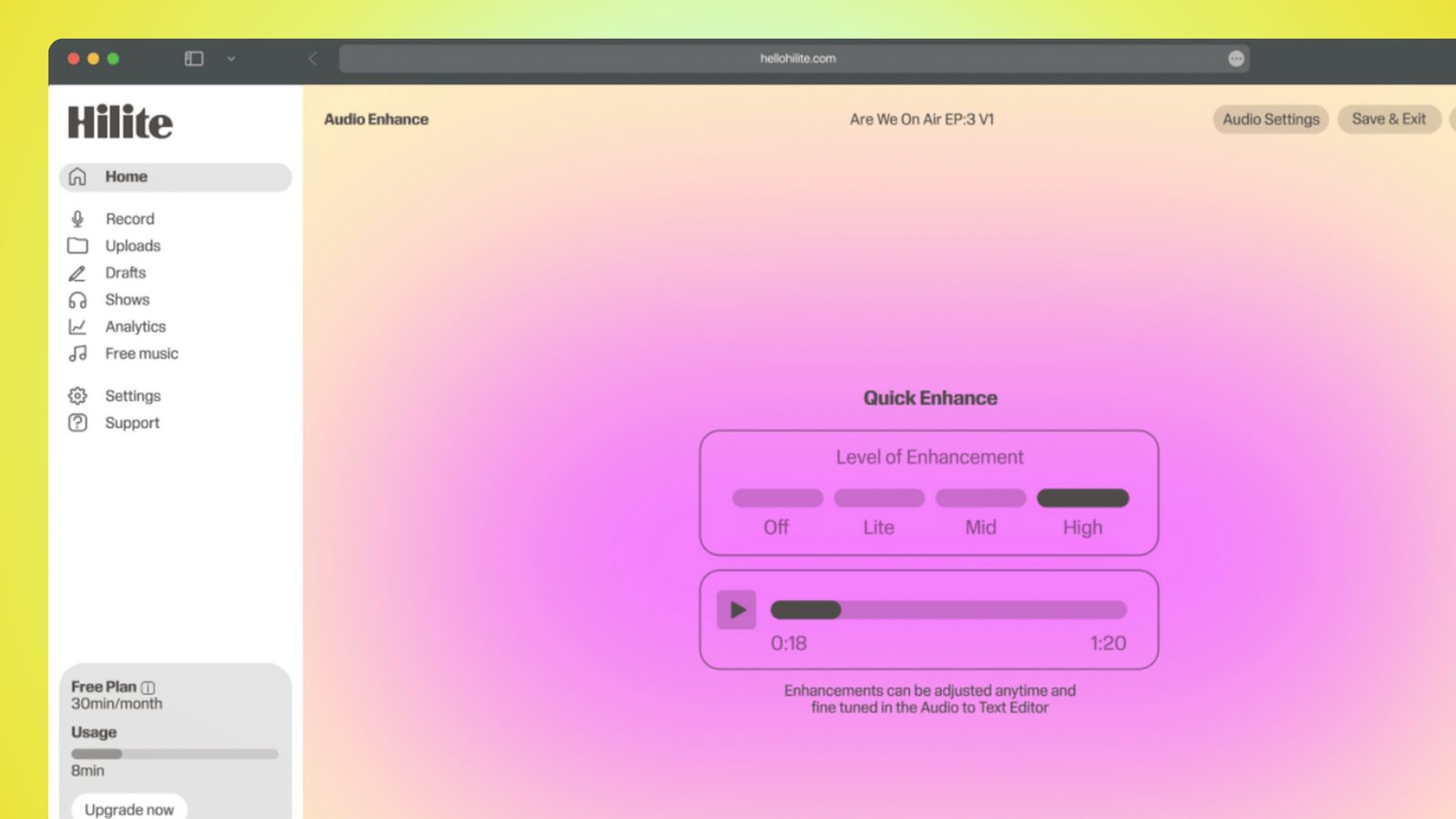
Made for podcasters and their teams
Trim the dead air off the top and tail, and every recording is ready to edit, enhance, and publish.



FAQ
Common questions
If you do not see your question here, the support team replies within one business day.
- Find them on the waveform first — they show up as narrow spikes in what should be a gap — then handle each one. If it falls in a pause, delete it and patch the hole with a copy of the quiet room tone from just before or after, because a stretch of absolute digital silence in the middle of gentle room noise is audible as a hole. If it's stuck to a word, reduce the volume of just those few milliseconds instead of cutting, so the word survives.
- Quieter than almost anything else you'd publish. Podcasts get mastered loud so they survive a car or a train; a sleep story is played at low volume in a silent room, and mastering it loud just makes the listener turn it down, which brings the noise floor and every breath closer to their ears. Around -18 to -20 LUFS with plenty of headroom works. The number matters less than this test: no single moment in the whole file should be noticeably louder than the rest.
- Very little, and never the heavy settings that suit a podcast voice. Compression works by pulling loud moments down and lifting quiet ones up — and in a sleep story the quiet parts are the point, so lifting them undoes the descent you deliberately recorded. It also raises the noise floor, breaths and mouth sounds along with the voice. Level the file instead, and if a single sentence is too loud, bring that sentence down by hand.
- De-essing turns down the narrow band of high frequencies where sibilance lives, and a light touch is all you need — a couple of decibels of reduction on the worst moments rather than a blanket setting. Too much and every S turns into a soft TH, which listeners notice even half asleep. Prevention beats repair here: recording slightly off-axis stops most sibilance from ever reaching the mic, so if it's a recurring problem, change the mic angle next time.
- With a long fade into nothing, never a cut. Finish speaking, leave the room tone running, then fade over at least 30 seconds — many published stories taper across the final two or three minutes. Don't put a sign-off, a call to action or a channel plug at the end; anyone still awake doesn't need it and anyone asleep will be woken by it. If you want to credit yourself, do it at the very start.
- No. Breath is part of what makes a slow read feel human and calming, and a voice with every breath stripped out sounds oddly mechanical. Remove the loud ones — the sharp gasp before a long sentence, the one that spikes on the waveform — and leave the rest, or simply turn the loud ones down a few decibels rather than deleting them. As with everything else here, the test is whether it's sudden, not whether it's tidy.
- Audacity is the genuine free option on a desktop, with a de-esser, noise reduction and fades all built in, though hunting spikes across a 30-minute file is slow work and it has to be installed, which rules it out on a work laptop or a Chromebook. Hilite runs in a browser tab with nothing to install, records straight into the same editor, and levels and cleans the whole file in one pass. Either way, the method matters more than the tool.
- You can, but it has to be genuinely constant. Rain and similar ambience work well because nothing in them ever arrives; music with a melody or a build does not. Start the bed before the first word, keep it low, and fade it out along with the voice at the end. Check any loop carefully for a seam — a click or a jump every 30 seconds is a small startle repeated hundreds of times.
Nothing sudden, right to the end
Level it, take out the spikes and fade the last few minutes, all in a browser tab with nothing to install.