Edit a sound bath recording
Audacity does all of this for free and it's the right tool if you already know it. The catch, in Audacity or anywhere else, is that almost every default setting is wrong for this material, because the defaults were designed for speech. A noise gate at any sensible speech threshold will chop the decay tails, and the tails are where the entire effect lives. Normalise hard or run a compressor at podcast settings and you flatten the dynamics that make it a sound bath rather than a drone. Planning and recording the session are separate jobs; this page starts with the file, and the whole method is gentleness — long fades measured in seconds, a light hand on noise reduction, and cuts placed in real silence rather than in a tail you can't hear yet.
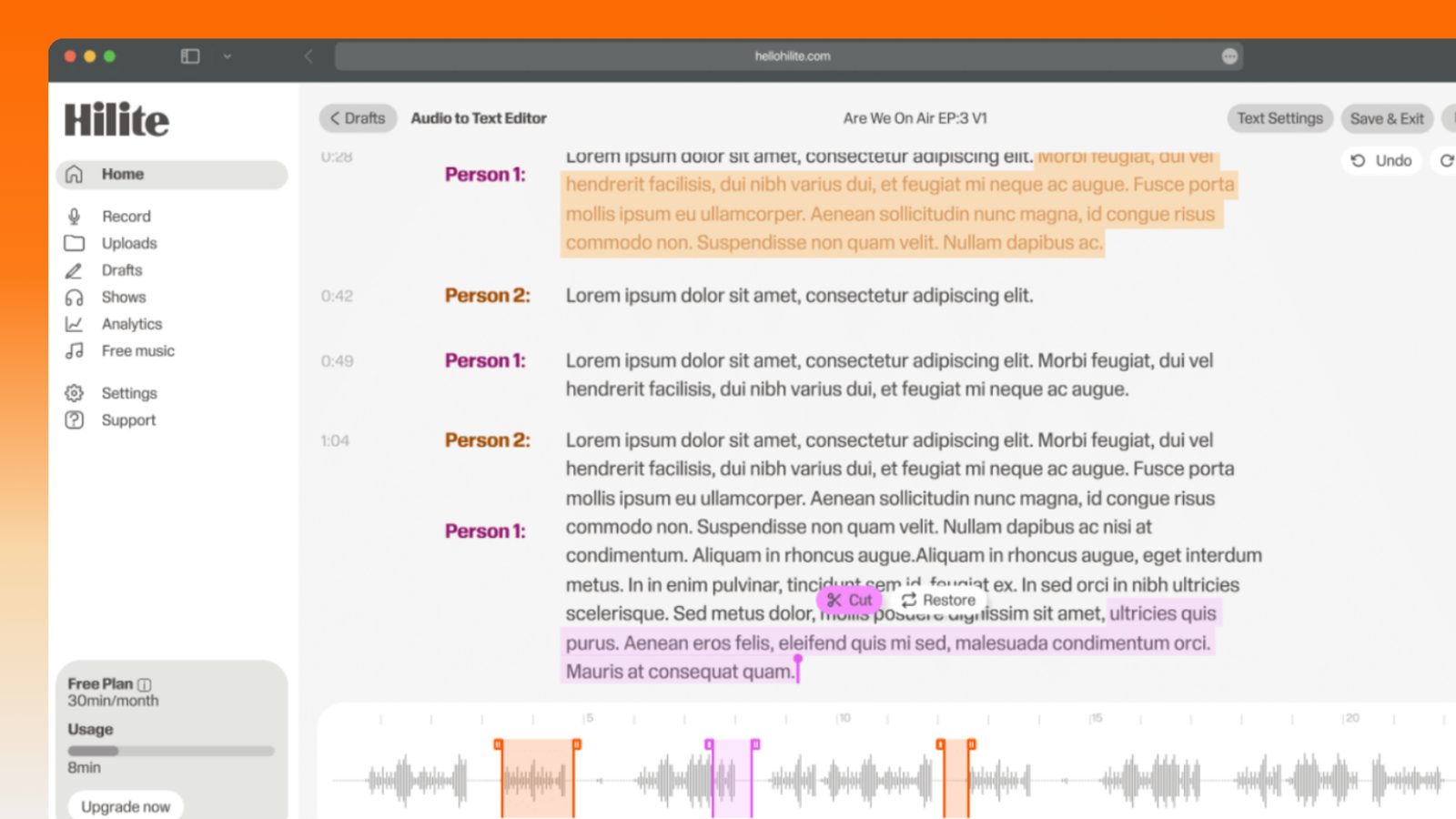
Edit a sound bath in four steps
- 1
Turn it up and find the real ends
Before you edit anything, listen loud, ideally on headphones, and work out where the tails actually stop. Decays carry on well past the point they vanish on laptop speakers, and the waveform will look like flat silence while there's still sound in it. Everything else on this page depends on knowing where that line is.
- 2
Trim the ends with long fades
Cut the setup shuffle at the start and the packing-up at the end, but place both cuts in genuine silence, not just where the picture goes quiet. Then fade in over a few seconds and fade out over ten or more from the last strike, so the final tail dissolves rather than stopping. A default fade of a few milliseconds is what makes a recording end with a click.
- 3
Ride out the cough, don't cut it
If someone coughs or a phone goes off over a decay, cutting leaves a hole in the tail that's more obvious than the noise was. Instead, dip the volume smoothly across a second or two and bring it back up — you lose a little of the bowl and nobody notices. Only cut when it lands in true silence between strikes, and even then fade in and out of the cut rather than butting it.
- 4
Clean lightly, then stop
Run the mildest noise reduction that takes the hiss or hum off, then check a long decay rather than a strike. If a tail now ends abruptly, wobbles, or picks up a metallic shimmer, it's too strong. Leave a little hiss, level the whole thing up as one gentle move, and export.

Merge audio inside the Hilite editor
Your uploaded files open directly in a focused editor view. Arrange your clips, preview the timeline, adjust transitions, and export when the track sounds perfectly right.
- Drag to reorder clips
- Trim starts, ends, and gaps
- Preview the full track before export
Input formats
Output formats
Built for every kind of audio
Whatever you are making, this tool helps you get to a cleaner, more useful result, then hand off to Hilite to enhance and polish.
- The defaults are wrongEvery preset in every editor assumes speech. Gates, de-noisers and compressors all treat a long quiet decay as something to remove, which is exactly the thing you recorded.
- The tail is the trackA bowl's decay runs for tens of seconds and fades below where you can hear it on laptop speakers. Every cut and every fade has to be placed with that in mind.
- Dynamics are the pointThe distance between a strike and its sustain is what makes this immersive. Squash it flat and you've made an hour of ambient wallpaper instead.
- Fixes that don't leave holesA cough over a decay can't be cut out, because you'd take the decay with it. Riding the level down over it keeps the track continuous.
Made for podcasters and their teams
Trim the dead air off the top and tail, and every recording is ready to edit, enhance, and publish.






FAQ
Common questions
If you do not see your question here, the support team replies within one business day.
- Something is gating them. A noise gate closes whenever the signal drops below a threshold, and it's set by default for speech, where anything that quiet is room noise. A bowl's decay falls below that threshold long before it has actually finished, so the gate slams shut mid-tail and the note stops dead. Aggressive noise reduction does the same thing by a different route. Turn off any gate, noise suppression or auto-clean feature entirely, then reach for reduction separately and gently.
- Raise the overall level if it's too quiet, but don't compress it. Normalising simply scales the whole file up so the loudest strike reaches a chosen ceiling, and that's fine — it changes nothing about the relationship between the strike and the tail. Compression is a different animal: it pulls the strikes down and pushes the quiet decays up, which is precisely the contrast you were recording. Run this material through a podcast-style compressor and it comes out as a flat, continuous drone with no impact and no space.
- Ride the level rather than cut, when it happens over a decay. Cutting removes the tail underneath the noise as well, so you swap a cough for a hole, and the hole is more distracting because the room disappears with it. Draw a smooth dip in the volume across a second or two around the noise and bring it back — the bowl loses a fraction of its sustain and no listener finds it. Cut only when the noise falls in genuine silence between strikes, and fade into and out of the cut. Some noises can't be saved at all, and an honest small cough is better than a mangled tail.
- Seconds, not milliseconds. A few seconds coming in from silence, and ten or more going out from the last strike, so the ending dissolves instead of stopping. The default fade in most editors is a tiny click-prevention fade of a few milliseconds, which is the wrong order of magnitude here and gives you an ending that just halts. Long fades also solve a practical problem: the last tail is still faintly sounding when you want to finish, and a slow fade lets you end where you like without ever cutting a note off.
- Find the ends by ear at high volume, not by eye on the waveform. Decays run on far below the point where the picture looks flat, so a cut that appears to be in silence is often sitting inside a tail, and the result is an audible chop. Turn the monitoring up, listen to the last twenty seconds, and mark the point where you truly stop hearing it. Then put your cut past that, and fade rather than cut, so even if you were a second optimistic the fade covers it.
- Use the lightest setting that works, and test it on a decay rather than on a strike. Noise reduction identifies a steady background and subtracts it, and the quiet, complex overtones at the end of a bowl's tail look a great deal like that background — so it eats them first. Apply a small amount, then listen to a long tail: if it now ends early, flutters, or takes on a shimmering metallic edge, back off. A faint constant hiss under a sound bath is far less noticeable than a decay that behaves strangely.
- Yes, and it's free and perfectly capable. Use the envelope tool for level dips and long fades, and its noise reduction at a low setting with a noise profile taken from real silence. Two cautions specific to this material: don't use Truncate Silence or any auto-clean, because they'll shorten exactly the gaps you want; and set fade lengths yourself rather than taking the defaults. The trade-offs are the usual ones — it's a download and an install, so it's no help on a locked-down machine, and the interface expects some prior knowledge.
- A wav if the destination accepts one, otherwise an mp3 at a high bitrate. This material is unusually unkind to heavy compression: long quiet decays and dense metallic overtones are the hardest thing for an mp3 encoder to handle, and at low bitrates you'll hear a watery, swirling quality in the tails that isn't there in the original. It's the opposite of speech, where a small file is fine. Export high, keep the untouched original, and if a platform re-encodes on upload, at least you gave it good material to start from.
Edit it without gating the magic
Long fades, level rides instead of cuts, and the lightest cleaning that works, in a browser tab.