Edit a yoga class recording
Editing a yoga class is mostly a matter of deciding what not to cut. Audacity is free and will do every job on this page, and GarageBand is already sitting on your Mac — both are real tools and neither is the wrong answer. What actually goes wrong isn't the software, it's an instinct every editor has: the raw file is full of long silences while the class holds pigeon for ninety seconds, and on the waveform those silences look like a mistake. They are not. They are the practice, and tightening them turns a class into a rushed instruction video that nobody can follow on a mat. Hilite opens the recording in a browser tab, so you can trim the front, level a voice that drifted and add a bed without installing anything.
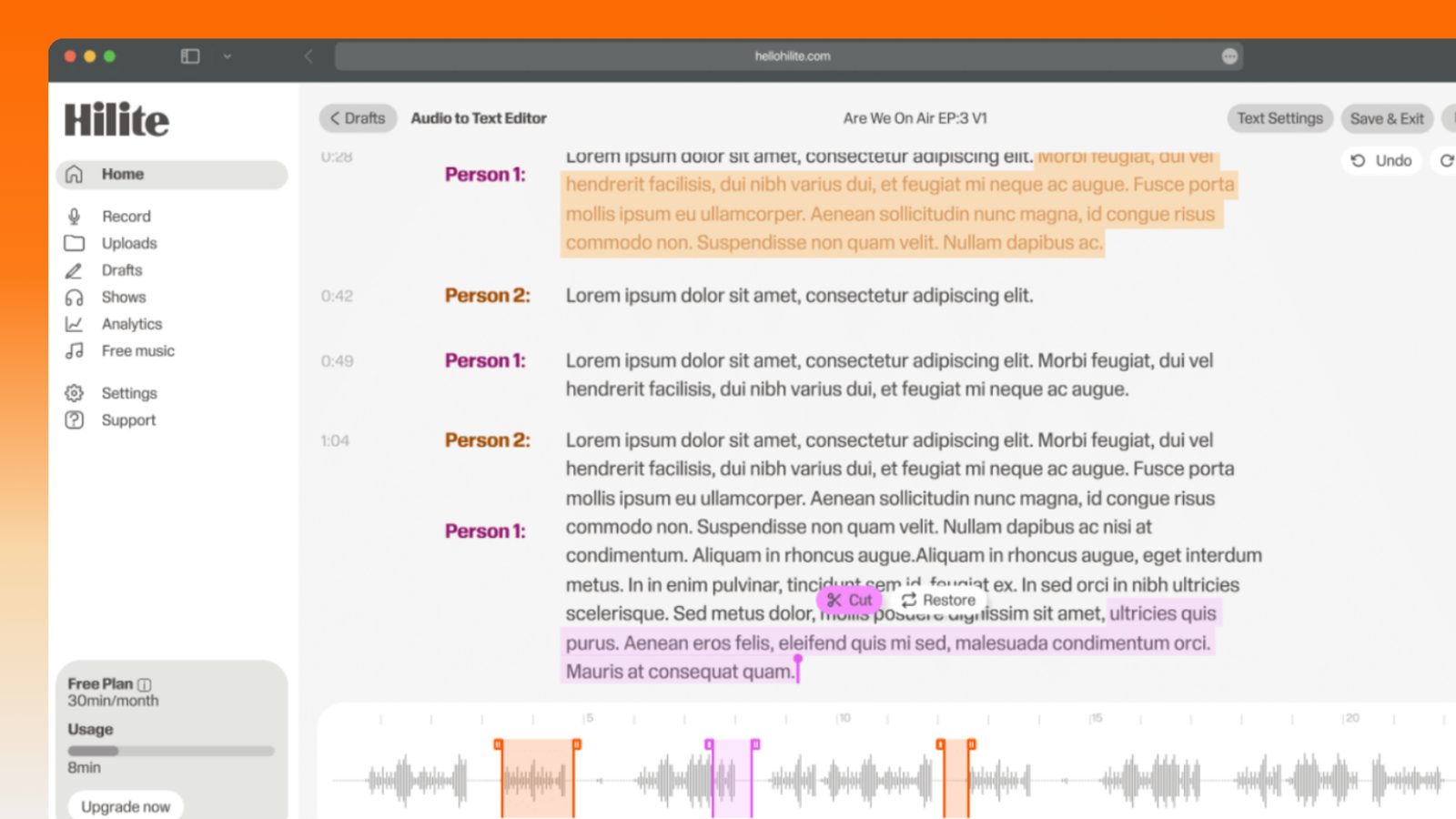
Edit a class recording in four steps
- 1
Cut the top and the tail
Find the first line that belongs to the class — usually a settling or breath cue — and cut everything before it. Do the same at the end, after the last word of the closing, and leave a couple of seconds of quiet rather than a hard stop.
- 2
Level the voice, then clean the noise
Level the whole track so the quiet cues in savasana sit close to the ones you gave standing at the front. Take the room hum down afterwards, gently, because heavy noise removal makes a soft voice sound underwater.
- 3
Leave the holds alone
Go through and resist every long pause. The only silences worth touching are accidents — a gap where you lost your thread, or forty seconds of nothing because someone knocked at the door.
- 4
Do the practice before you publish
Put a mat down and take your own class from the recording, all the way through. It is the only way to catch a cue that arrives after the moment it was needed, and you will find at least one.
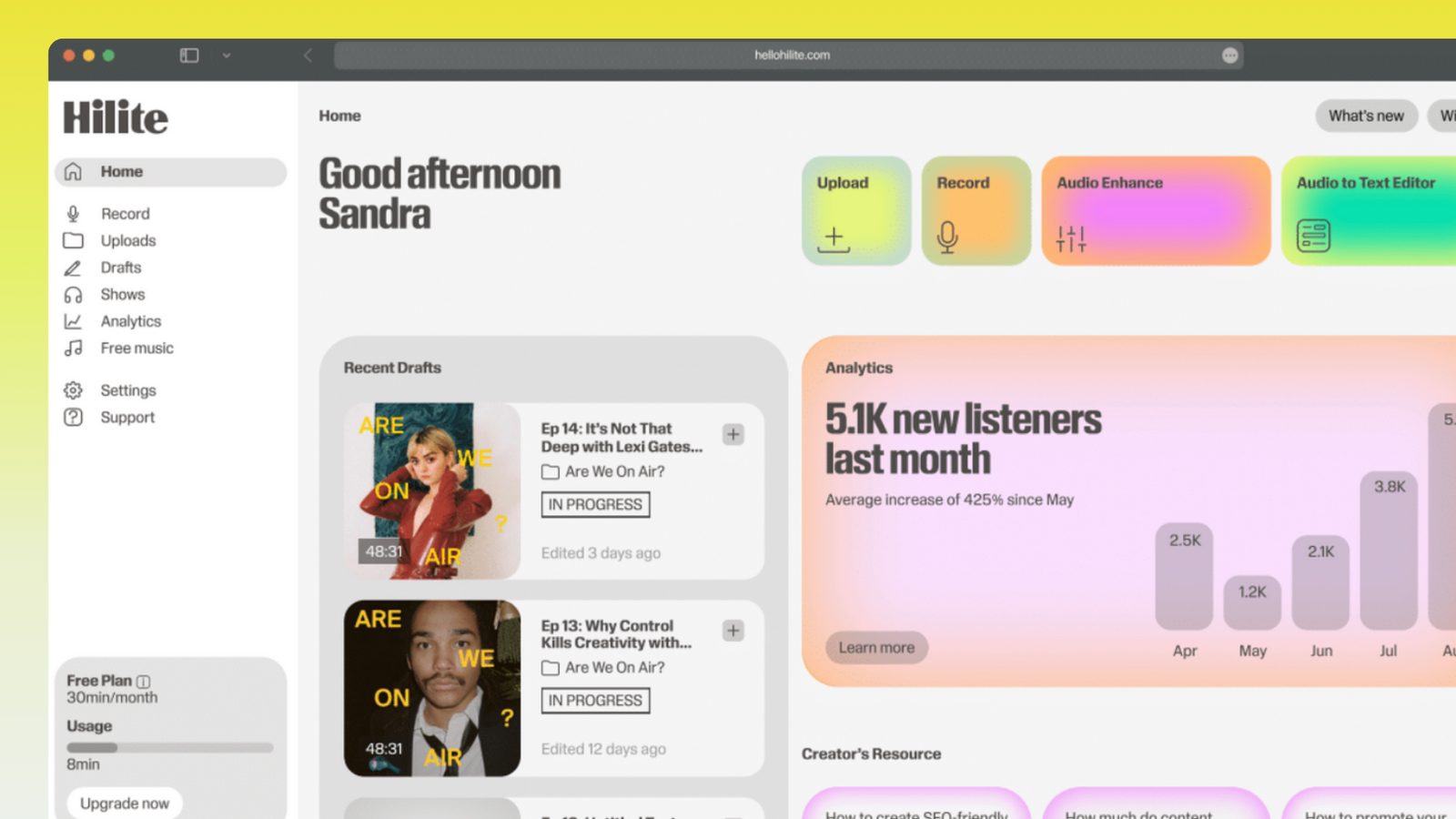
Merge audio inside the Hilite editor
Your uploaded files open directly in a focused editor view. Arrange your clips, preview the timeline, adjust transitions, and export when the track sounds perfectly right.
- Drag to reorder clips
- Trim starts, ends, and gaps
- Preview the full track before export
Input formats
Output formats
Built for every kind of audio
Whatever you are making, this tool helps you get to a cleaner, more useful result, then hand off to Hilite to enhance and polish.
- The silence is the contentNinety seconds of nothing feels endless when you're staring at a waveform and exactly right when you're in the pose. Judge the gaps from the mat, not from the screen.
- Even out a voice that movedLevelling brings the cues you gave from the back of the room up to match the ones from the front, so the student isn't reaching for the volume every few minutes.
- Lose the pre-class chatThe first minute is almost always mats, latecomers and a joke about the weather. Cut in on the first real breath cue.
- Add a bed you're allowed to useA licensed ambient track sits under the voice and can be turned down under every cue. A commercial song baked into the recording is what gets the class taken down.
Made for podcasters and their teams
Trim the dead air off the top and tail, and every recording is ready to edit, enhance, and publish.

FAQ
Common questions
If you do not see your question here, the support team replies within one business day.
- No — the long pauses are the reason the recording works. When you're editing, a ninety-second hold shows up as a flat line on the waveform and every instinct says to trim it, because in a podcast or a lecture that would be dead air. On a yoga track it's the pose. Cut it to twenty seconds and the student is being hurried out of a shape they'd only just settled into, which is the single most common complaint about home practice audio. The only silences to remove are the ones that weren't teaching: you losing your place, a phone going off, a stretch where you clearly forgot to say anything. If you're unsure whether a gap is too long, time it against what you'd actually hold in the room.
- Level the track, which lifts the quiet passages towards the loud ones so the student isn't constantly adjusting the volume. Be aware of what it can't fix: when you walked away from the mic, it recorded more room and less of you, so pulling that section up brings the room's hum and echo up with it. It'll be the right loudness and still sound distant. If a stretch is unusable, sometimes the honest fix is to re-record just those cues in the same room and drop them in. For the next class, clip a lapel mic to your top so the distance never changes in the first place.
- Yes, as long as it's music you're licensed to publish — royalty-free or a library track you've paid for, not a song from your teaching playlist. A live class and a published recording are two different permissions, and lots of teachers find that out when a track gets flagged. Keep the bed well under the voice, quieter than feels right while you're editing, because a listener lying down with their eyes closed hears music far more prominently than you do at a desk. It's worth fading the music down a touch under the transition cues so a direction never has to compete. A bed also has one practical use: it covers the small differences in room tone between takes.
- On the first line that belongs to the practice. Almost every recording opens with two or three minutes of setting up — mats unrolling, someone arriving late, you asking whether anyone has a sore shoulder this week — and none of it means anything to a person pressing play at home six weeks later. Cut in on the first settling or breath cue and let that be your opening. If you want a proper introduction, record a short one separately afterwards and put it on the front: it lets you say the length of the class, what props are needed and who it's for, which is far more useful than the real start ever is.
- Roll out a mat and do the whole practice to your own recording before you publish it. You cannot hear this while scrubbing through a waveform, because in the editor you already know what's coming next — on the mat you don't, and a cue given half a beat after the moment it was needed becomes obvious immediately. Note the timestamp, keep going, and fix them all at the end. The usual fixes are small: move a cue earlier by trimming the silence in front of it, or record a short replacement line and drop it in. Expect to find one or two even in a class you've taught a hundred times.
- A little, and less than you think. A steady hum from a radiator or traffic outside is worth taking down, because a student practising in a quiet room at low volume will hear it for the full hour. But noise removal works by deciding what isn't voice, and a yoga class is full of quiet, breathy speech that a heavy setting will chew up — the softer your savasana voice, the more damage it does. Apply it gently, then listen to the quietest passage rather than the loudest to check. Room sounds that belong to the class, like breathing or the odd movement, are worth keeping.
- Export mp3 for anything you're publishing. A 45-minute class as a wav is several hundred megabytes, which is slow to upload, slow for a student to download and pointless for spoken word. An mp3 at a normal spoken-audio bitrate keeps a class comfortably small enough to stream on a phone with patchy signal, which is exactly where these get played. If you're sending the file to someone else for further editing, a wav is the right choice — the difference only matters when the file is going to be processed again.
- You can, and for trimming the front and back it's perfectly reasonable. Where a phone gets frustrating is the part that matters here: judging pauses across a 45-minute file means moving around a long timeline precisely, and a small screen makes it fiddly enough that people start cutting things they shouldn't. Levelling and noise cleanup are also easier where you can hear the result on decent headphones. A browser editor works on a phone, a tablet or a laptop with the same file, so it's reasonable to trim on the phone straight after class and do the careful pass later.
Trim the chat, keep the quiet
Open the recording in a browser tab, level the voice, leave the holds where they are, and take the class yourself before you publish it.