Edit an affirmations recording
Editing an affirmations recording comes down to one number: how long you leave between the lines. Audacity is free and can do all of it, and the trimmer in your phone's voice recorder is fine for a rough pass — but neither makes it easy to keep every gap the same length, and that is the thing that decides whether the track works. Leave roughly as long as the line itself, so the listener has room to say it back, then make every other gap match. Uneven spacing is what makes an affirmations track feel restless and slightly urgent, which is the exact opposite of what it's for. Hilite opens the recording in a browser tab where you can set the gaps, level each line and lay a bed underneath.
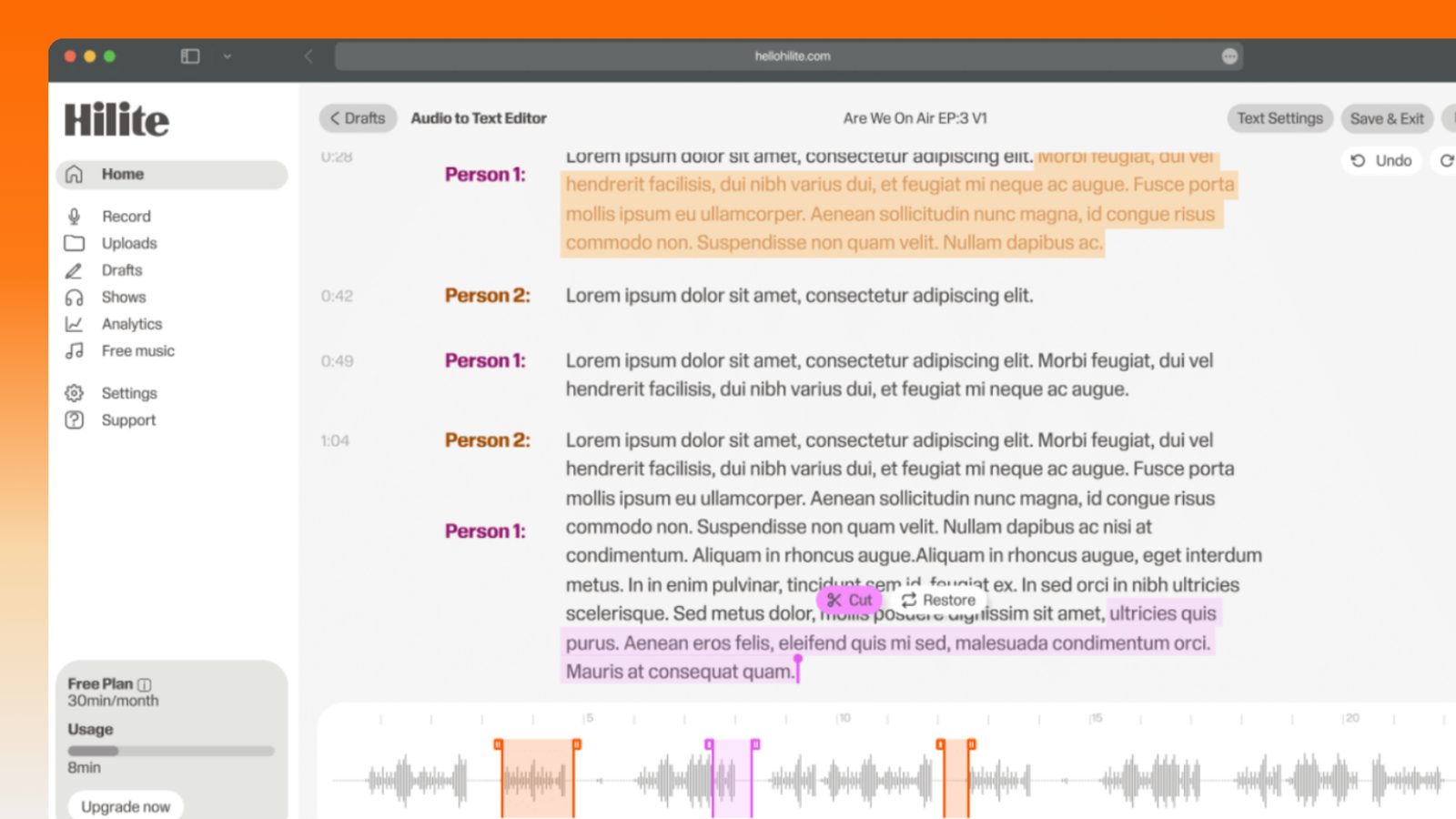
Edit an affirmations track in four steps
- 1
Separate the lines
Trim the raw recording so each affirmation is its own clean piece, with the false starts, page turns and the breath before you spoke taken off the front of each one.
- 2
Pick one gap and use it everywhere
Say a line out loud at the pace a listener would, time it, and use that as your gap — usually four to six seconds. Then set every single gap to that number instead of eyeballing them.
- 3
Level every line to match
Level the whole track so a line you happened to say more softly lands at the same loudness as the rest. This matters far more here than in ordinary speech, because the silences either side make each difference plain.
- 4
Add the bed, close the loop, export
Bring a licensed music bed in well under the voice, then make the end match the start: the same length of silence at the tail as your standard gap, and the music at the same level. Export mp3 and listen to the join twice.
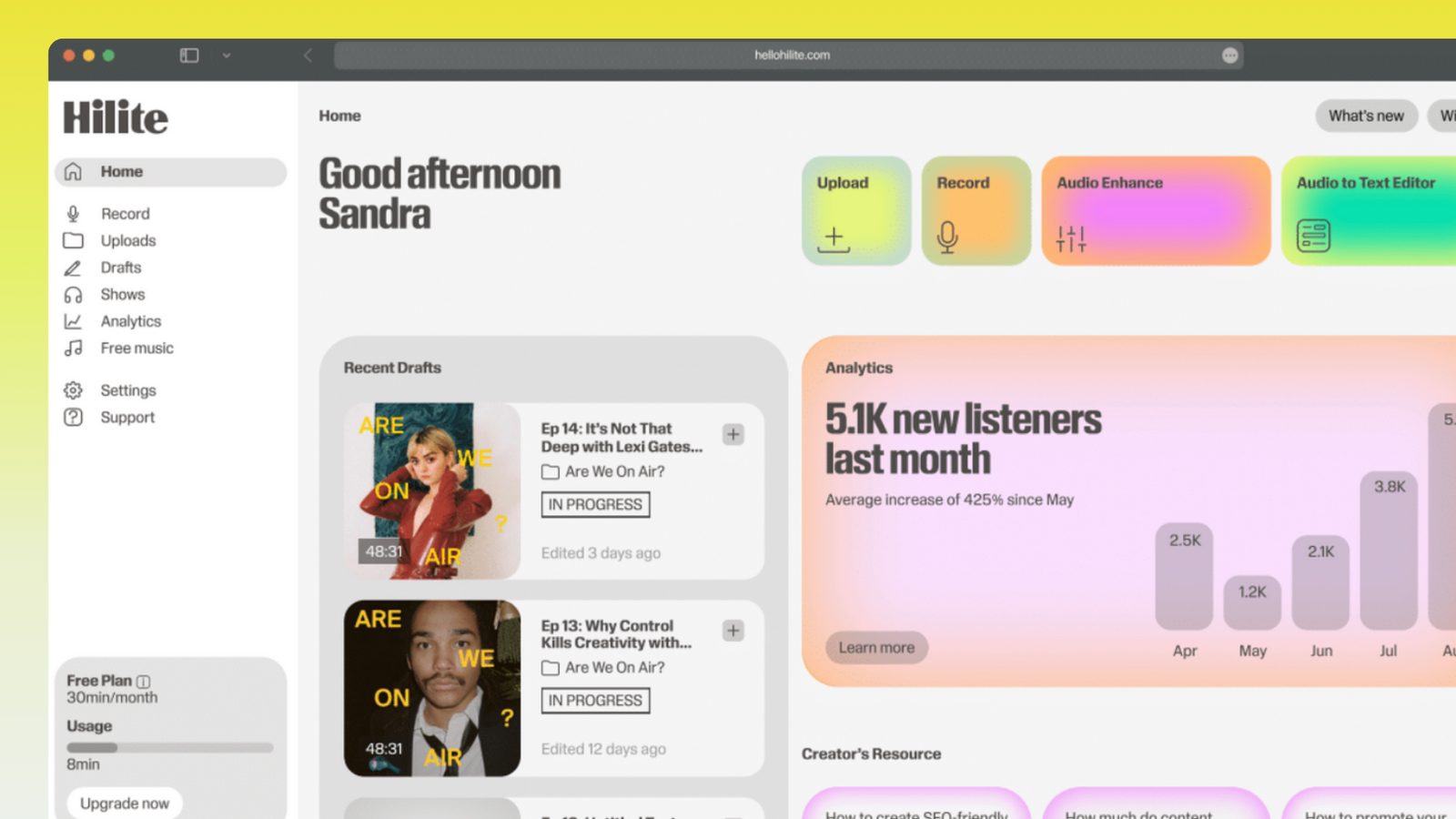
Merge audio inside the Hilite editor
Your uploaded files open directly in a focused editor view. Arrange your clips, preview the timeline, adjust transitions, and export when the track sounds perfectly right.
- Drag to reorder clips
- Trim starts, ends, and gaps
- Preview the full track before export
Input formats
Output formats
Built for every kind of audio
Whatever you are making, this tool helps you get to a cleaner, more useful result, then hand off to Hilite to enhance and polish.
- The gap does the workA listener repeating the line needs the space to do it. Too short and they're chasing the track; too long and their attention wanders off somewhere else.
- Identical, not roughly equalThe ear picks up an irregular rhythm long before the mind names it. Matching gaps is what makes a track feel settled rather than restless.
- Repetition exposes volumeOne quiet line in a podcast passes unnoticed. In a track of thirty short lines with silence between them, every level difference is obvious.
- A loop with no seamIf the track is meant to run on repeat, the join has to sound like just another gap — same silence, same music level, no click.
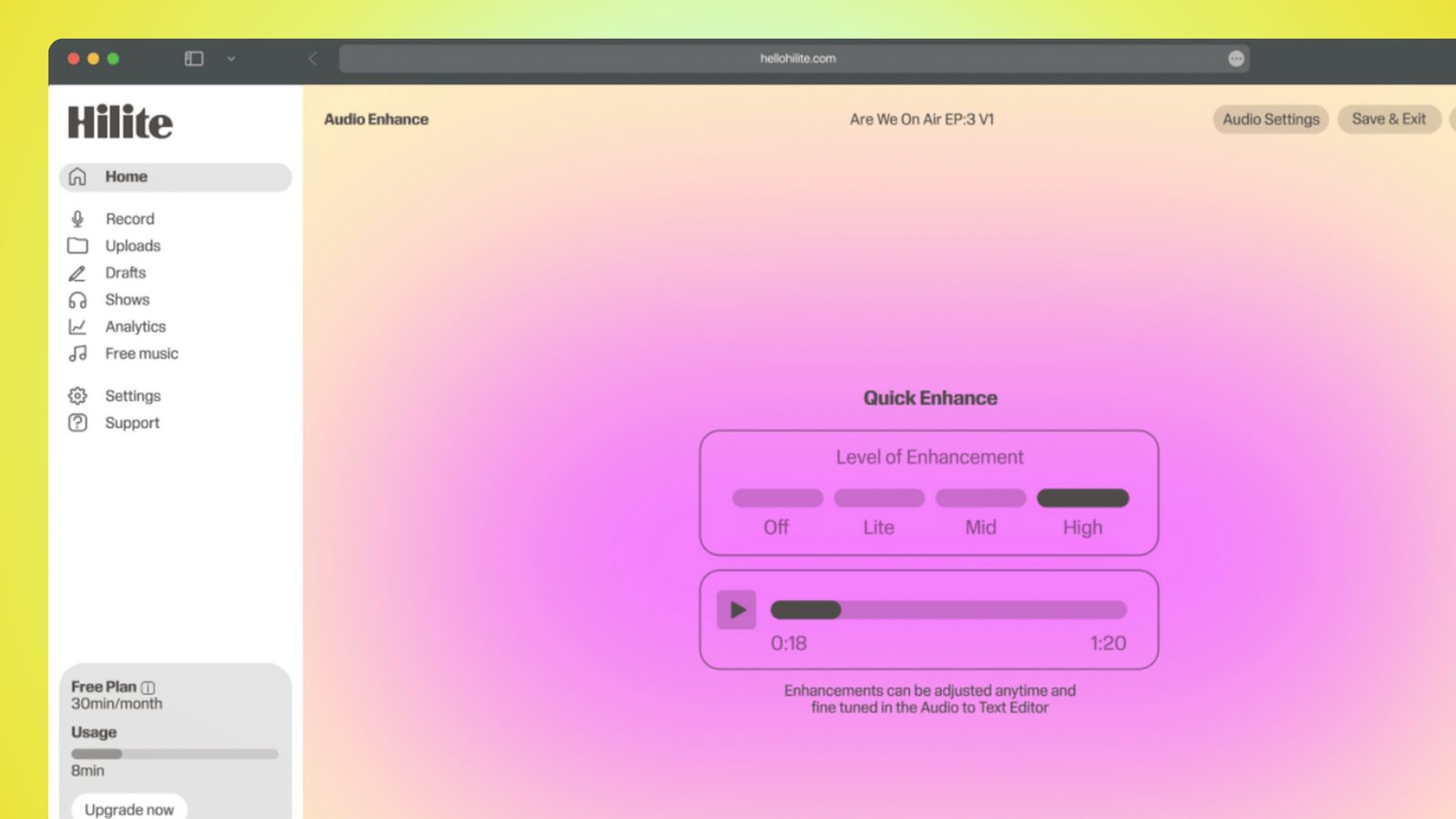
Made for podcasters and their teams
Trim the dead air off the top and tail, and every recording is ready to edit, enhance, and publish.





FAQ
Common questions
If you do not see your question here, the support team replies within one business day.
- Long enough for the listener to say the line back, which in practice means about as long as the line itself — usually four to six seconds for a short affirmation. The way to set it is not to guess: say one of your lines out loud at the unhurried pace someone would use, time it, add a beat, and that's your number. Then apply that exact number to every gap in the track. Short gaps are the more common mistake and they make the track feel like it's rushing you, which undoes the point. If the affirmations are longer sentences, the gaps get longer to match, but they still all match each other.
- Almost always because the gaps aren't the same length. When you edit by eye, one gap ends up three seconds and the next seven, and the listener's ear registers the irregular rhythm even though they'd never be able to say what's wrong. It reads as slight unpredictability, which is exactly what a calming track shouldn't have. Fix it by choosing one gap length and setting every gap to that value rather than adjusting each one until it looks right. Uneven volume between lines does the same thing, so it's worth checking both.
- Level the whole track, and be more careful about it than you would with normal speech. In a recording of continuous talk, one line said a bit more softly disappears into the flow. In an affirmations track, each line is a short island with silence either side, and a listener who has just set their volume for line one will notice line two arriving quieter. It's worth listening to the exported file at a low volume, the way someone would at night, because that's where a soft line vanishes altogether. If one line is dramatically off, re-record just that line rather than pushing the levelling harder.
- It's a good fit for looping, because the content is repetition by design and someone using it as a background during work or sleep won't want it stopping after eleven minutes. Two things make it work. The end of the track has to hand over to the start cleanly, which means the silence at the tail plus the silence at the head should add up to exactly one of your standard gaps, not two. And if there's music underneath, it needs to be at the same level and ideally the same point in its phrase at both ends. Test it by playing the track on repeat and listening through the join twice without watching the screen.
- Treat the join as one more gap rather than an ending and a beginning. Decide on your gap length first, then split it: leave roughly half of it after the final affirmation and the other half before the first one, so a listener on repeat hears a gap the same size as all the others. Make sure both ends are true silence with no fade artefact and no clipped word, since a hard cut on a music bed produces an audible click. If you're using music, either fade the bed out and in over the join, or choose a track that starts and ends on the same quiet level.
- Quieter than feels right while you're editing. You're listening at a desk with the words already in your head, so you'll set the bed too high; the listener has their eyes closed and hears the music far more than you do. A useful test is to turn the whole track down to bedtime volume and check that every word is still clearly there — if the music is competing at all, it's too loud. The gaps are where this really shows, because when the voice stops the music is suddenly alone and any level that seemed subtle under speech now feels like the main event. Use a bed with no lyrics and no strong melody, and one you're licensed to publish.
- Cut the ones at the start of a line and keep the track breathing otherwise. A sharp inhale right before an affirmation is a recording artefact — it sits in the middle of what should be clean silence and draws attention to the microphone rather than the words. A soft breath at the end of a line is usually fine and removing every trace of breath makes a voice sound synthetic, which is not what you want in a track meant to feel human. The practical rule is to clean the two seconds before each line thoroughly and leave the rest alone.
- Between five and fifteen minutes for most uses, which at a normal pace is roughly twenty to fifty affirmations. Shorter than five and it's over before someone has settled; much longer and people stop finishing it, unless it's designed to loop in the background, in which case the length matters far less than the join. Fewer affirmations repeated twice often works better than a long list heard once, because the repetition is the point and a familiar line is easier to say back. Say the length in the title so someone can pick one that fits the time they have.
Set the gap, then keep it
Open the recording in a browser tab, space the lines evenly, level every one to match and check the loop before you export.