Edit an ASMR recording
Noise reduction is what ruins ASMR edits, and it ruins them invisibly. The triggers people came for — whispering, tapping, soft brushing — sit at almost exactly the level a noise reducer is aiming at, so the standard settings take the content out along with the hiss and hand you back a track that is clean, quiet and completely dead. Audacity's Noise Reduction is the free tool most people reach for and it can absolutely do this job, but only if you drag the defaults a long way down, and most tutorials tell you the opposite. Hilite gives you a gentler version in a browser tab with the trimming, levelling and export alongside it, so you can hear what's being removed before you commit to it.
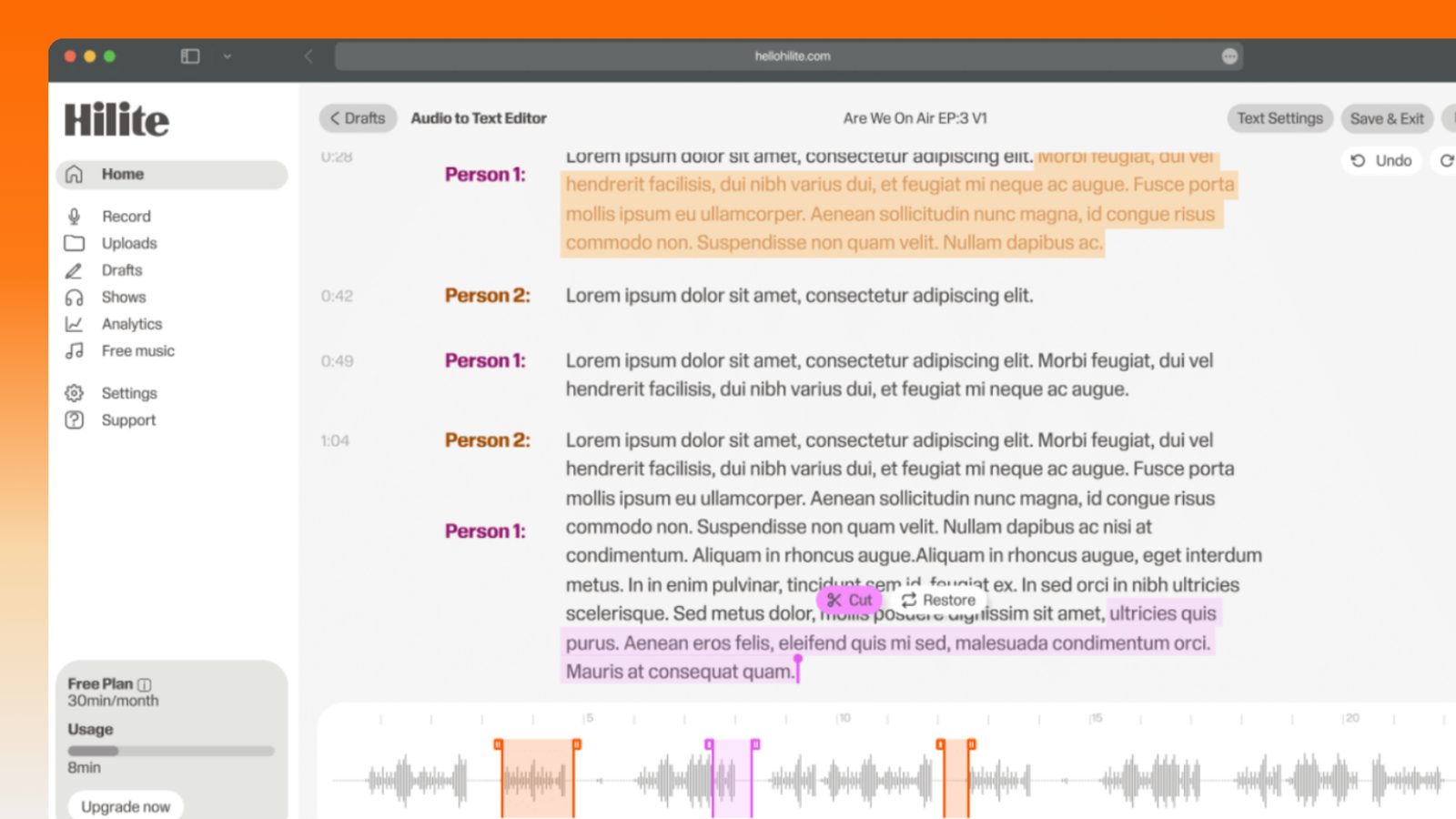
Edit an ASMR recording in four steps
- 1
Listen right through before you touch it
In headphones, at the volume a viewer would use. Note where the mistakes are and what actually needs fixing, because most ASMR takes need far less work than the instinct to process suggests.
- 2
Cut mistakes into the ambience
Make the cut at the quietest point you can find, and cross-fade across the join rather than butting two pieces together. The room tone should carry straight through so nothing drops out.
- 3
Use the least noise removal that helps
Apply the gentlest setting, then listen to the whispers and the brushing, not the silence. If the triggers have lost their edge or gained a watery ring, undo it and use less.
- 4
Level lightly and export in stereo
Even out anything that jumps, leave plenty of headroom, and keep it quieter than a podcast. Export in stereo at a high bitrate so the fine high-frequency detail survives.
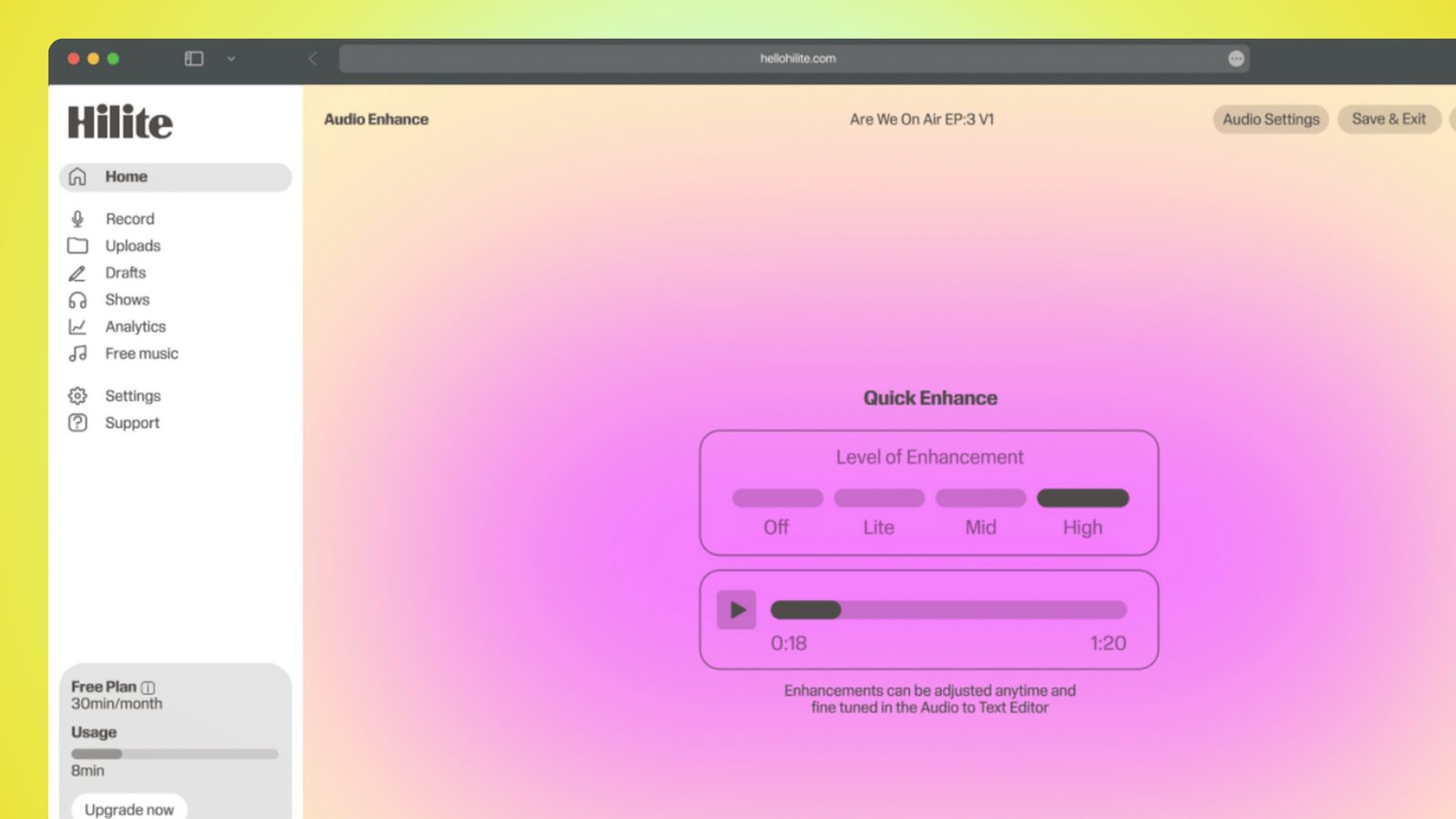
Merge audio inside the Hilite editor
Your uploaded files open directly in a focused editor view. Arrange your clips, preview the timeline, adjust transitions, and export when the track sounds perfectly right.
- Drag to reorder clips
- Trim starts, ends, and gaps
- Preview the full track before export
Input formats
Output formats
Built for every kind of audio
Whatever you are making, this tool helps you get to a cleaner, more useful result, then hand off to Hilite to enhance and polish.
- Noise reduction is the trapHiss and whispering live at the same level, so a tool aimed at one takes the other. If a pass makes the room quieter and the tapping thinner, you removed the thing people came for.
- Don't normalise it loudASMR is not a podcast and should not be mastered like one. Pushing it to broadcast loudness squashes the gap between a soft brush and a sharp tap, which is the whole dynamic range of the genre.
- Stereo is the closenessThe sense of somebody beside you is the difference between the two channels. Anything that narrows or collapses it — a mono export, a heavy-handed effect — takes the intimacy out.
- Cuts that keep the roomA clean cut leaves a hole where the ambience was, and that silence is more jarring than the mistake was. Edit into the room tone and cross-fade the join.
Made for podcasters and their teams
Trim the dead air off the top and tail, and every recording is ready to edit, enhance, and publish.



FAQ
Common questions
If you do not see your question here, the support team replies within one business day.
- As little as you can get away with, and judge it on the triggers rather than the silence. The problem specific to ASMR is that hiss and whispering occupy nearly the same level, so a noise reducer set to clear the room will strip the whispering with it — you end up with silence that's beautifully clean and content that has gone thin and watery. If you're using Audacity's Noise Reduction, take the reduction amount well down from its default, into single-figure decibels, and use a low sensitivity. Then listen specifically to the quietest trigger in the take. If it lost its texture, undo and use less.
- Almost always over-processing, and usually more than one thing stacked up. Noise reduction has taken the top off the whispers, compression has squashed the difference between a soft brush and a sharp tap, and normalising to a loud target has removed what was left of the dynamics. There may also be a mono collapse in there, which kills the sense of someone beside you. The fix is to go back to the original take and do far less: one gentle noise pass at most, no heavy compression, no loudness target, and a stereo export. If the raw file sounded good and the edit doesn't, the edit is the problem.
- Not to the levels you'd use for music or a podcast. ASMR is listened to in headphones, often at night, often at a low volume by choice, and pushing the file to broadcast loudness makes it feel loud and compressed rather than close. Level the track so nothing jumps out unpleasantly and leave real headroom below the ceiling — the finished file should sit noticeably quieter than most things in a playlist. Consistency matters more than loudness: a listener who has settled in shouldn't be startled by one tap that's much louder than everything around it.
- Cut where the room tone is steady, and never leave digital silence. If you slice a clean section out and join the two ends, the constant background of the room stops dead for an instant and starts again, and that gap is far more noticeable than the cough you were removing — in ASMR the ambience is part of the experience. Put your edit points at the quietest moments either side of the mistake, apply a short cross-fade across the join so the two backgrounds blend, and listen to the join in headphones. If you can hear a step in the noise, lengthen the fade.
- Very sparingly, and less than you'd use on speech. The safe move is a gentle high-pass filter to take out rumble below the range of anything you actually recorded — traffic, air handling, desk thumps — which cleans things up without touching the triggers. Beyond that, heavy EQ in the high frequencies is where whispers get harsh or lispy, and compression flattens the contrast between quiet and sharp sounds that gives the genre its texture. If you're reaching for a de-esser because the whispers are sibilant, the better fix is usually mic position on the next take.
- Work in stereo from start to finish and check the export settings before you upload. The closeness people describe comes from the difference between the two channels — a sound arriving slightly earlier and louder in one ear is what places it beside the listener's head — so anything that narrows that difference removes the effect. Don't convert to mono, don't apply an effect that sums the channels, and if you're editing left and right separately, make sure every cut lands at the same point in both. Then listen back in headphones rather than on speakers, because that's the only way to hear whether the image survived.
- Mostly not, and it's worth accepting that early. A hissy take can be improved a little with a light noise pass, but the point where the noise becomes properly clean is the same point where the whispers and brushing go with it. Low-frequency thumps carried through a desk are worse still — they're mixed with the content and effectively permanent. The honest answer is nearly always to record it again in a quieter room, later at night, with the mic closer so you need less gain. Twenty minutes of re-recording beats an hour of processing that leaves the track lifeless.
- Keep a wav master and export a high-bitrate mp3 for uploading. This matters more for ASMR than for speech, because the triggers are quiet high-frequency detail — the fine texture of brushing, the tail of a tap — and that is exactly what low-bitrate mp3 encoding smears first. A 128 kbps file that sounds fine on a podcast can make ASMR sound papery and swishy. Export at 256 kbps or higher, or upload a wav where the platform accepts one. Always keep the original take, because you'll want it if you ever redo the edit with a lighter hand.
Do less to it
Cut the mistakes, keep the room, use the smallest noise pass that helps, and let the quiet stay quiet.