Edit an audiobook recording
Editing an audiobook is not the same job as editing a podcast. You aren't making it sound nice, you're hitting numbers — every file between -23dB and -18dB RMS, no peak above -3dB, and a noise floor below -60dB RMS. A chapter can be warm, well-read and genuinely enjoyable and still be rejected because the room hums a little too loudly underneath it. Audacity will do all of this for free if you're willing to learn where its measurement tools live and run each step by hand, and plenty of people do. Hilite runs in a browser tab with the recording and the editor in one place, which matters when you're going to measure the same file four times before it's finished.
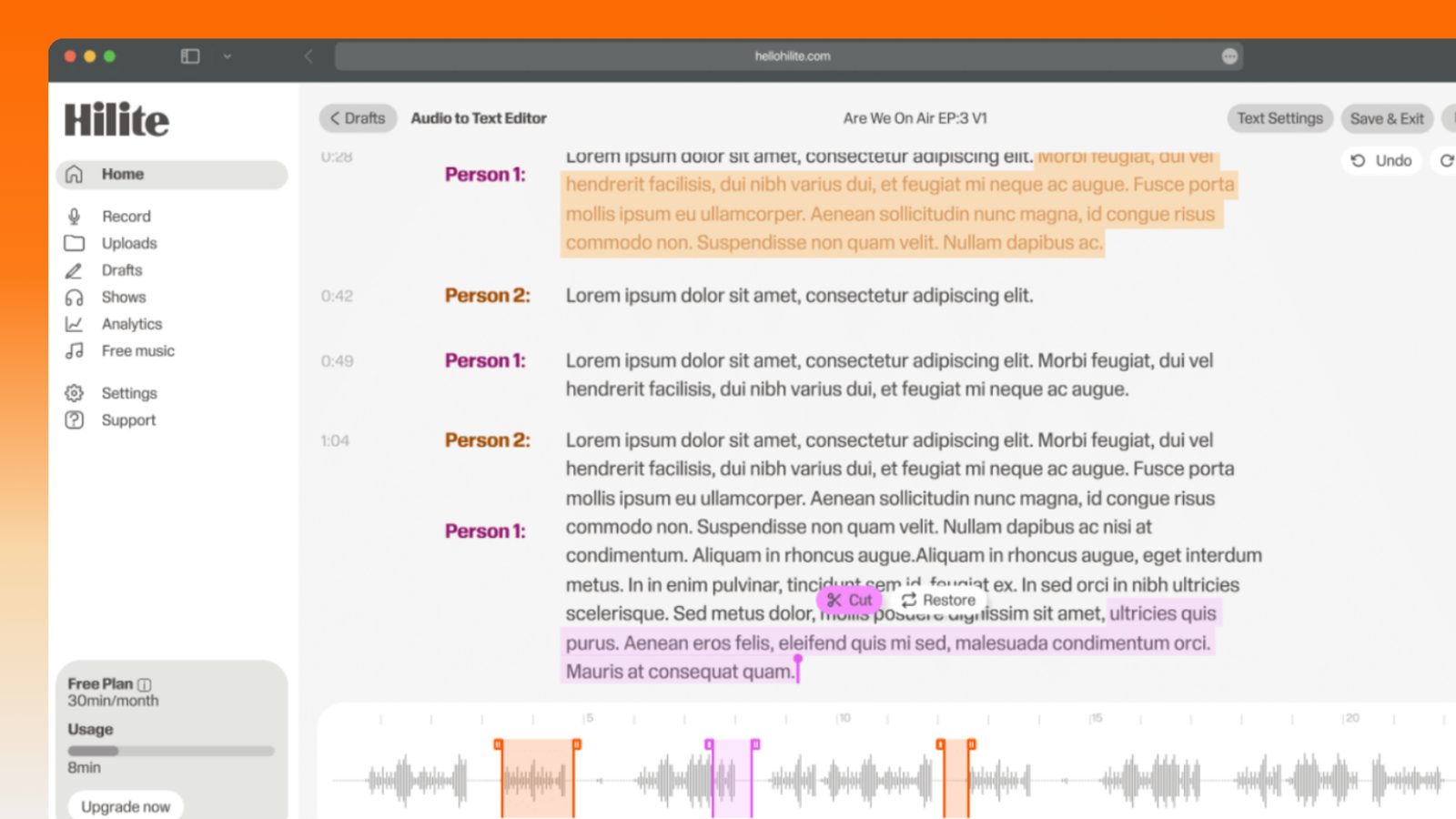
Edit an audiobook chapter in four steps
- 1
Edit the read first
Do the content pass before you touch any processing. Take out the retakes, keep the best pass of each punch and roll, close the long thinking gaps, and listen across every join with your eyes shut — the ear catches a bad edit that the waveform hides.
- 2
Clean the noises
De-click the mouth noise, cut the chair creaks and page turns, and fill any hole you leave with room tone from that same session — not from another day. Digital silence pasted into a gap is audible as a small drop-out.
- 3
Hit the three numbers
Reduce the noise floor gently first, then set the level so the file lands between -23 and -18dB RMS, then limit so nothing peaks above -3dB. Measure again after each of those three moves, because every one of them changes the other two.
- 4
Top, tail and export
Put half a second to a second of room tone before the first word and one to five seconds after the last. Export as constant bitrate mp3, 192kbps or higher, 44.1kHz, one file per chapter, named so the running order is obvious.
Merge audio inside the Hilite editor
Your uploaded files open directly in a focused editor view. Arrange your clips, preview the timeline, adjust transitions, and export when the track sounds perfectly right.
- Drag to reorder clips
- Trim starts, ends, and gaps
- Preview the full track before export
Input formats
Output formats
Built for every kind of audio
Whatever you are making, this tool helps you get to a cleaner, more useful result, then hand off to Hilite to enhance and polish.
- Spec, not tasteMost editing is a judgement call. This isn't: the file either measures inside the window or it doesn't, and no amount of it sounding lovely in your headphones will get it past a failed noise floor.
- Leave the breaths inCut every breath and the narrator stops sounding human. Take out the gasps and the ones that land as a mic pop, soften the rest, and keep enough that the read still sounds like somebody with lungs reading a book.
- Every step moves the numbersNoise reduction lowers your RMS. Levelling raises it. De-clicking nudges both. Measure after each step rather than once at the end, or you'll fix the noise floor and quietly fail the loudness.
- Head, tail and the sampleEach chapter is its own file with a short silence at the start and a longer one at the end, plus a retail sample cut from a section that stands alone. These are the details people forget and get sent back for.
Made for podcasters and their teams
Trim the dead air off the top and tail, and every recording is ready to edit, enhance, and publish.


FAQ
Common questions
If you do not see your question here, the support team replies within one business day.
- Three numbers. RMS between -23dB and -18dB, which is the average loudness across the whole file. Peak no higher than -3dB, which is the single loudest instant. Noise floor no higher than -60dB RMS, measured in the silence where nobody is speaking. Alongside those: 0.5 to 1 second of room tone at the head, 1 to 5 seconds at the tail, one chapter per file, under 120 minutes each, and 192kbps constant bitrate mp3 at 44.1kHz.
- Use an analysis or loudness readout on the finished file rather than judging it by eye or ear — a waveform that looks healthy can sit several decibels outside the window. Measure the whole chapter, not a selected passage, because RMS is an average and a quiet opening will drag it down. For the noise floor, select a few seconds of the room tone where nobody is speaking and measure that separately; it's a different measurement on a different part of the file, which is the bit most people get wrong.
- Gently, and preferably at the source. A light noise reduction pass using room tone from that session as its sample will usually take a marginal file under -60dB without side effects. Pushing it harder starts producing a watery, warbling quality around soft sounds like s and f, and that fails a human listen even when it passes the number. If the floor is a long way over — an audible fan or traffic — no amount of processing rescues it convincingly and it's faster to re-record the session in a quieter hour with the mic closer to you.
- No. A narrator with no breaths sounds inhuman, and listeners notice it as an unease they can't identify. Remove the ones that are genuinely distracting: gasps before a long sentence, breaths that pop the mic, double breaths after a punch and roll join. For the rest, reduce them rather than delete them — pull the volume of the breath down so it sits under the words instead of cutting it to silence. Deleting a breath entirely also shortens the pause, which changes the rhythm of the read.
- Clicks are tiny — often a few milliseconds — so zoom right in and either cut the click and close the gap, or select just the click and reduce its volume, which is safer because it doesn't shift anything after it. Doing hundreds by hand is the reality of audiobook editing, so a de-click pass first and manual work on whatever survives is the sane order. Prevention beats repair: clicks come from a dry mouth, so drink water through the session, and a bite of green apple between takes is the trick most narrators end up using.
- It's the one to five minute clip listeners preview before buying, and it's a separate file you submit alongside the chapters. Cut it from a passage that makes sense with no context — usually a page or two from an early chapter with some narration and a little dialogue, not a cliffhanger and not a section that starts mid-scene. Start and end it on a clean sentence, top and tail it like a chapter, and put it through exactly the same processing so it measures inside the same spec. It's the first thing anyone hears, so it's worth choosing rather than grabbing.
- Half a second to a second before the first word, and one to five seconds after the last. Crucially, that silence should be room tone from the session, not digital silence — a file that opens with true zero and then cuts to room noise as the voice starts has an audible click of ambience arriving. Copy a piece of the room tone you recorded at the head of the session and use it for both the head and the tail of every chapter from that session.
- Most rejections come down to a handful of things: the noise floor sitting above -60dB, the RMS falling outside the -23 to -18dB window, peaks over -3dB, inconsistency between chapters recorded weeks apart, or over-processing that leaves the voice sounding artificial. Nearly all of them are measurable before you submit, so check every chapter individually rather than trusting one good file to represent the set. If the read itself was flagged rather than the audio, that's a different fix — and re-recording a section with punch and roll matched to the original session is far better than patching in a pickup recorded cold.
Measure it before you submit it
Three numbers stand between a good read and a chapter that gets sent back — check all three, every file.