Compare › Zencastr
Hilite vs Zencastr
Zencastr is focused on remote recording. Hilite is focused on the full podcast workflow: record, edit, enhance, publish, and share.

Compare › Zencastr
Zencastr is focused on remote recording. Hilite is focused on the full podcast workflow: record, edit, enhance, publish, and share.
Key differences
Hilite guides you step by step from upload to publish. Zencastr focuses on a broader production workflow that can take longer to master.
Hilite assumes no prior audio knowledge. Most creators publish their first episode faster with a guided workflow.
Hilite takes you from raw audio to live on Spotify and Apple Podcasts without leaving the platform.
Feature by feature
| Feature |  Hilite Hilite | Zencastr |
|---|---|---|
| Text-based editing | Edit audio by editing the transcript | Varies by tool |
| AI show notes & titles | Auto-generated every episode | Available on some plans |
| Audio enhancement | One-click Studio Sound | Manual or plan-dependent |
| Podcast hosting & RSS | Built-in — all platforms | Usually requires a separate host |
| Free plan | Free plan available | Limited free tier |
If you want to record, edit, enhance, and publish without juggling multiple tools, Hilite is built for that workflow end to end.
Start creating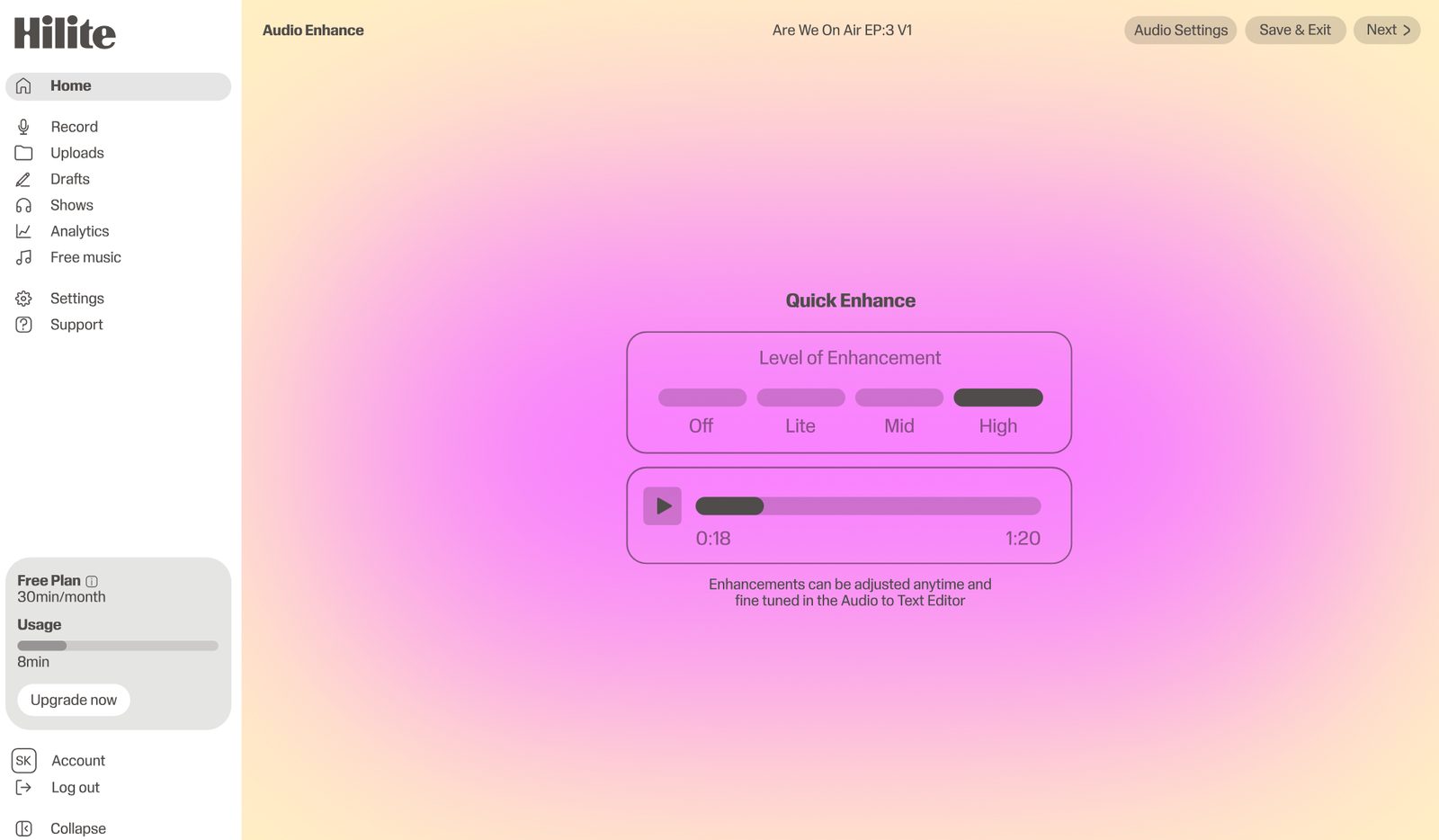
“I went from idea to published episode in one afternoon.”What our creators say, consistently
FAQ
Yes, if you want the workflow beyond remote recording. Hilite supports recording, transcript editing, audio enhancement, episode content, publishing, and sharing.
Choose Hilite if your biggest challenge is finishing the episode after recording: editing, enhancement, show notes, publishing, and sharing.
Choose Zencastr if dedicated remote recording and separate speaker tracks are the main thing you need.
Yes. Hilite is designed around podcast post-production and publishing: transcript editing, enhancement, content generation, publishing, and sharing.
Yes. You can use a dedicated remote recorder for the conversation and then use Hilite to edit, enhance, generate content, publish, and share.
Hilite is usually the better fit for solo podcasters because it focuses on the full podcast workflow, not just remote guest recording.
Edit, enhance, and publish your podcast — free, in one place.