Record a sleep story
Record a sleep story so that it loses energy as it goes. Voice Memos or Windows Voice Recorder will capture the words perfectly well, and for a first attempt they're enough, so start there if that's what you have open. What no recorder can do for you is the read itself, and the read is the whole thing. A sleep story has to descend — slower and quieter at minute twenty than at minute two — which is the opposite of every other kind of narration you've been taught. Recording late in the evening helps more than any microphone will, because your voice already sits lower and slower by then.
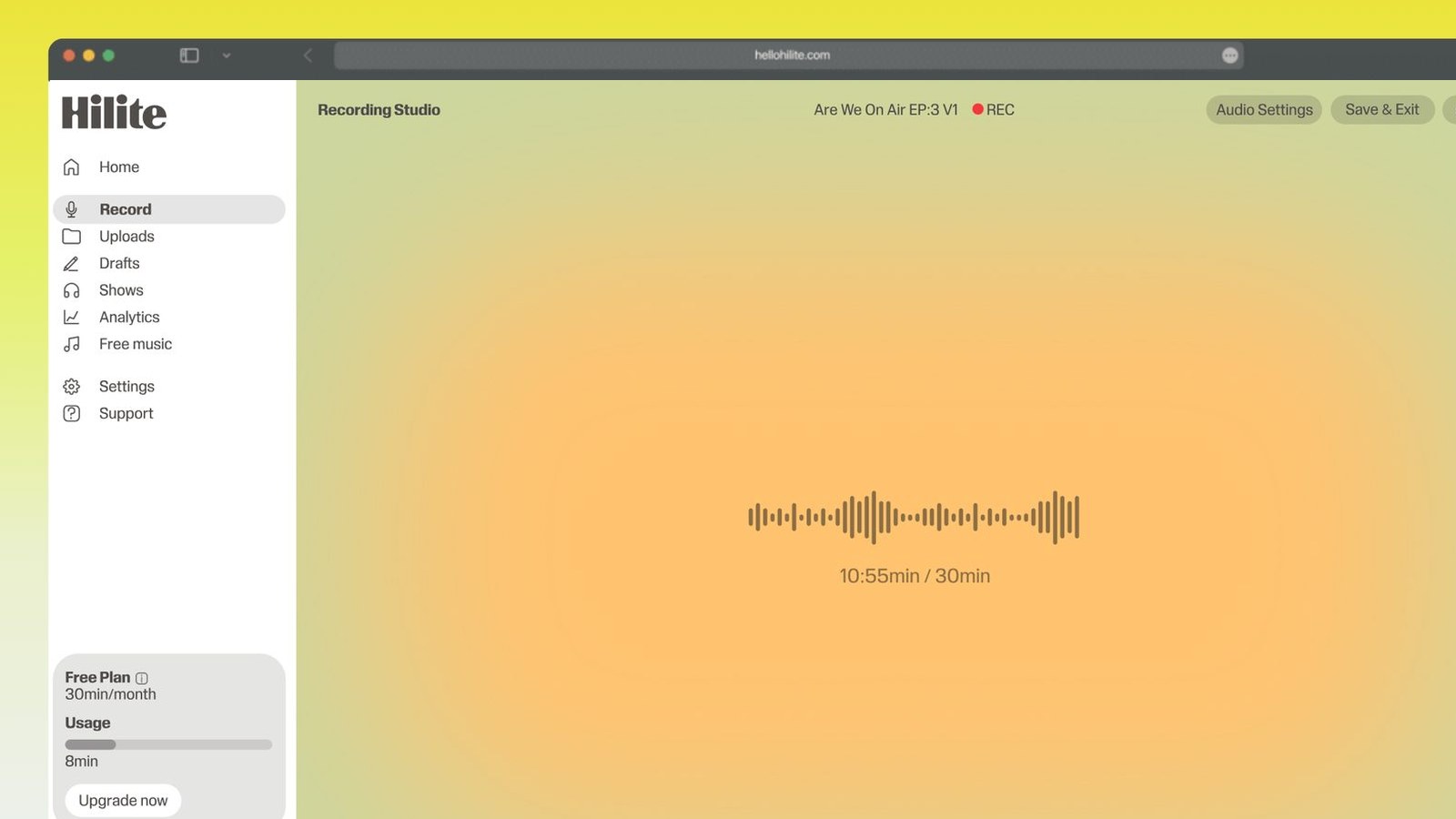
Record a sleep story in four steps
- 1
Record in the evening
Your voice naturally sits lower and slower late in the day, which is exactly the read you're after and is very hard to fake at 9am. The house is quieter then too — no traffic, no neighbours, no washing machine under the floor.
- 2
Angle the mic past your mouth
Set it a hand's width away and turned about 20 to 30 degrees off to one side, so the puff of air from a P or a B goes past the capsule rather than into it. A pop filter helps as well, but the angle does more than the filter does.
- 3
Get rid of the paper
Read from a screen with the brightness right down and scroll with a trackpad, not from stapled pages — page turns are the single most common noise in home-recorded sleep stories. Silence every notification, and keep water at room temperature within reach.
- 4
Let it descend
Mark your script into three parts and drop a gear at each mark: slower, quieter, flatter. Keep the last section on the mic rather than trailing off it — quiet is good, inaudible just makes people reach for the volume.
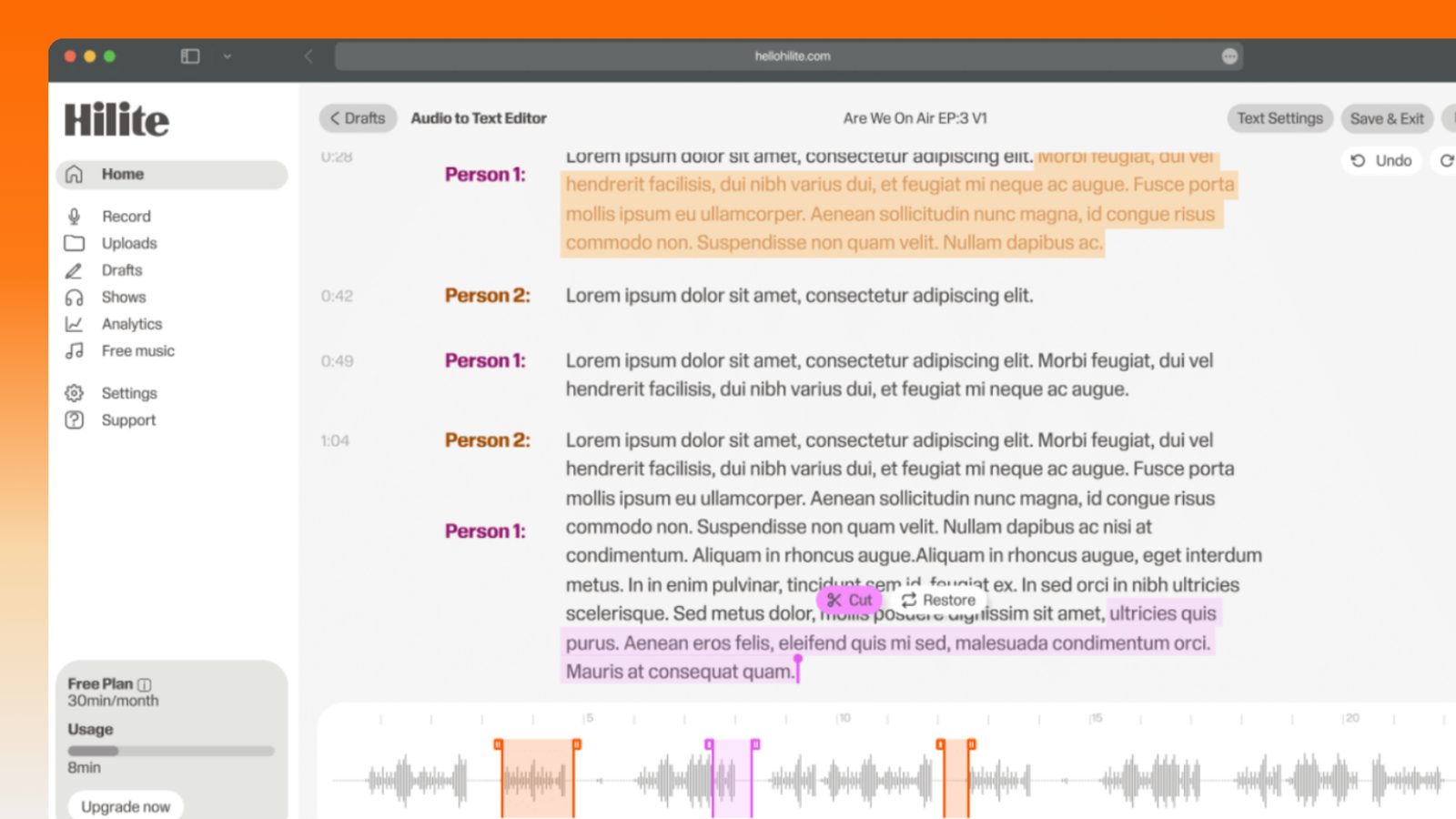
Keep working inside the Hilite editor
Your uploaded files open directly in a focused editor view. Arrange your clips, preview the timeline, adjust transitions, and export when the track sounds perfectly right.
- Record straight into the browser
- Watch levels as you speak
- Keep the take, or run it again
Input formats
Output formats
Built for every kind of audio
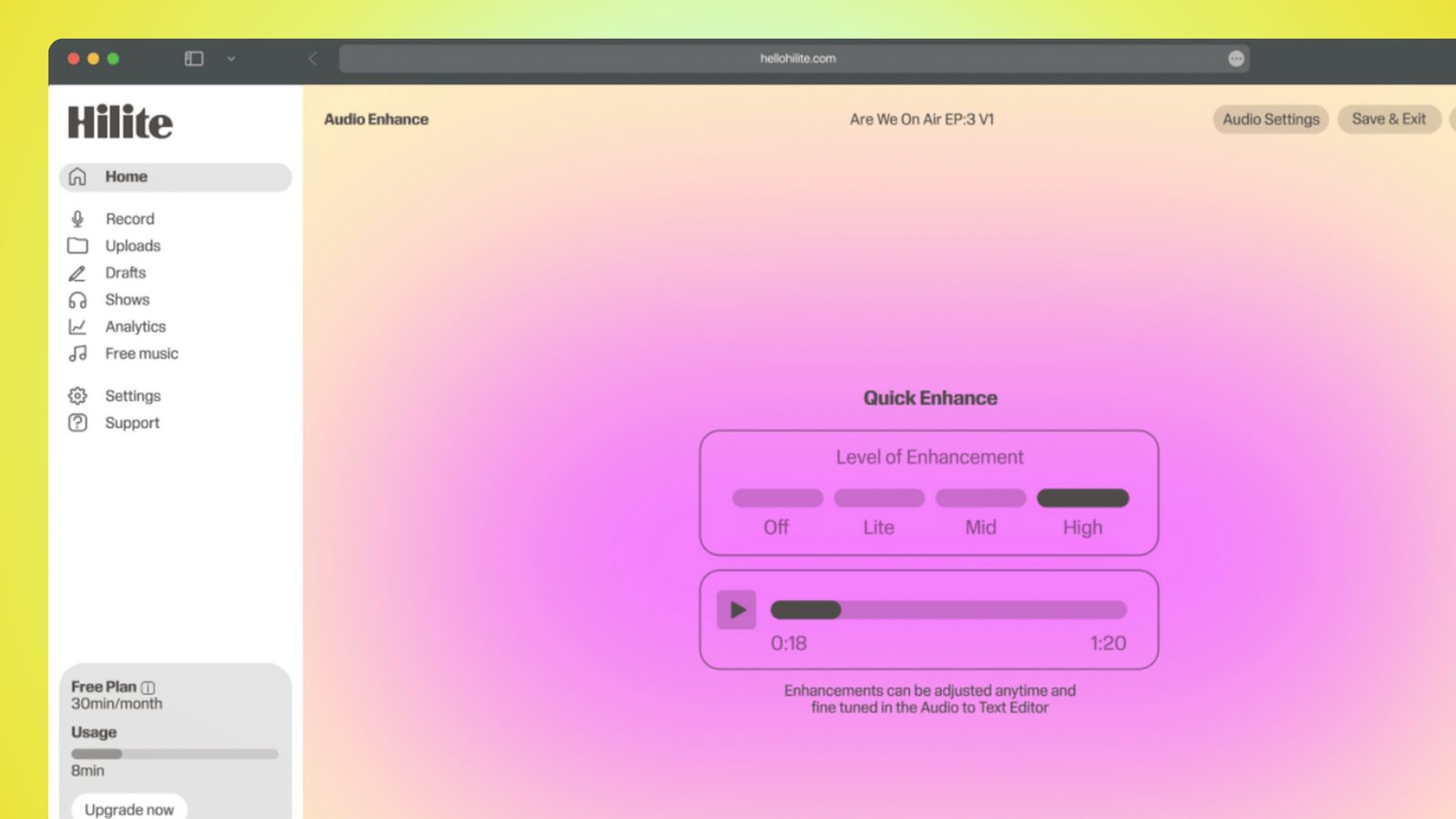
Whatever you are making, this tool helps you get to a cleaner, more useful result, then hand off to Hilite to enhance and polish.
- The energy has to fallEvery instinct trained into narrators — build interest, lift the ending, land the last line — is wrong here. Start gently, then get slower and quieter with each section until the last page is barely more than a murmur.
- Plosives are the enemyPeople listen to these on earbuds, in bed, in the dark. A popped P that would vanish in a podcast lands as a thump right inside someone's ear at low volume, and it wakes them.
- Don't perform itNo character voices, no dramatic pauses, no rising and falling drama. The listener isn't following a plot, they're being given something dull enough to let go of, and a good performance keeps them awake.
- Small noises get bigA page turn, a chair creak, a lip smack — all inaudible over a commute, all obvious at bedtime volume. Fix the causes while recording, because they're painful to remove afterwards.
Made for podcasters and their teams
Trim the dead air off the top and tail, and every recording is ready to edit, enhance, and publish.


FAQ
Common questions
If you do not see your question here, the support team replies within one business day.
- Between 20 and 45 minutes, with 25 to 30 the most common. Most listeners are asleep in the first 10 to 15 minutes, so the later part isn't really being followed — but it still has to be there, and it still has to not startle anyone, because a file that ends abruptly at minute 22 can wake someone as surely as a loud noise can.
- Turn the mic 20 to 30 degrees off-axis so you're speaking across it rather than straight into it, and keep about a hand's width of distance. That single change removes most plosives on its own. A pop filter or foam windshield adds more protection, and in a pinch a sock stretched over the mic genuinely works. If you can feel a puff of air on the back of your hand held in front of your mouth, the mic is feeling it too.
- Start at around 100 words a minute, against roughly 150 for ordinary conversation, and slow down from there as you go — by the last few pages you might be at 80. Pause longer than feels comfortable at full stops, especially in the second half. The thing to avoid is a constant slow pace, which is only half the effect; the descent is what actually signals to a listener that it's alright to stop paying attention.
- Late evening, if you can. Voices sit lower and move more slowly at the end of the day, so you get the tone you want without acting it, and acted calm is audible. It also happens to be the quietest time in most homes. If you must record in the morning, warm up properly first and read something aloud for five minutes so you're not starting cold and bright.
- Drink room-temperature water rather than cold, and sip between paragraphs rather than mid-sentence. Skip dairy and coffee in the hour before you record — both thicken saliva, which is what clicks actually are. The old narrator trick is a bite of green apple, and it does help. If your mouth is still noisy, take a proper break instead of pushing through, because clicks are tedious to remove one at a time later.
- No — that's ASMR, which is a different thing with a different audience. Whispering removes the low warmth in your voice that makes a sleep story soothing, and it also puts every consonant and mouth sound right at the front. Speak quietly at your normal pitch, close to the mic, with the energy down but the voice still supported. Quiet and gentle, not breathy.
- Yes, and a recent phone a hand's width away in a soft room sounds better than people expect. Where phone recorders stop is the part that matters most for this: they trim the ends only, so you can't cut out a swallow in the middle, you can't even the volume so nothing spikes, and you can't add the long fade at the end. Those three are exactly what stops a sleep story waking someone up.
- Not at all, and plenty of the best-known sleep stories have nothing under them. If you do want a bed, pick something with no melody and no changes, start it before the first word and keep it well below the voice. What you must avoid is anything that builds, arrives or stops — a swell or a sudden silence at minute 15 is far more likely to wake someone than plain voice would have been.
Read it down, not up
Record straight into the browser and the file is already sitting in an editor when you finish reading.